


Page 130 - Textbook of Pathology, 6th Edition
P. 130
114 Haematoma is the extravascular accumulation of blood clot  primary events: activation of platelets and of clotting system
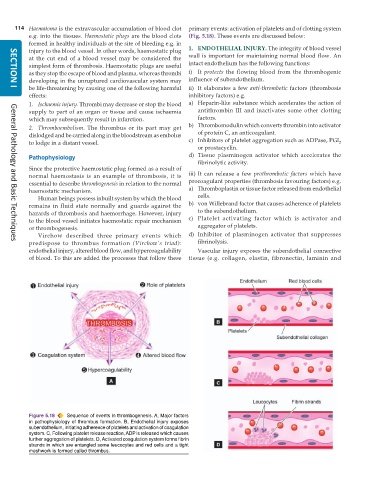
           e.g. into the tissues.  Haemostatic plugs are the blood clots  (Fig. 5.18). These events are discussed below:
           formed in healthy individuals at the site of bleeding e.g. in
           injury to the blood vessel. In other words, haemostatic plug  1. ENDOTHELIAL INJURY. The integrity of blood vessel
           at the cut end of a blood vessel may be considered the  wall is important for maintaining normal blood flow. An
           simplest form of thrombosis. Haemostatic plugs are useful  intact endothelium has the following functions:
           as they stop the escape of blood and plasma, whereas thrombi  i) It  protects the flowing blood from the thrombogenic
           developing in the unruptured cardiovascular system may  influence of subendothelium.
           be life-threatening by causing one of the following harmful  ii) It elaborates a few anti-thrombotic factors (thrombosis
     SECTION I
           effects:                                            inhibitory factors) e.g.
           1. Ischaemic injury. Thrombi may decrease or stop the blood  a) Heparin-like substance which accelerates the action of
           supply to part of an organ or tissue and cause ischaemia  antithrombin III and inactivates some other clotting
           which may subsequently result in infarction.           factors.
           2. Thromboembolism. The thrombus or its part may get  b) Thrombomodulin which converts thrombin into activator
           dislodged and be carried along in the bloodstream as embolus  of protein C, an anticoagulant.
           to lodge in a distant vessel.                       c) Inhibitors of platelet aggregation such as ADPase, PGI 2
                                                                  or prostacyclin.
           Pathophysiology                                     d) Tissue plasminogen activator which accelerates the
                                                                  fibrinolytic activity.
           Since the protective haemostatic plug formed as a result of
           normal haemostasis is an example of thrombosis, it is  iii) It  can release a few prothrombotic  factors which have
           essential to describe thrombogenesis in relation to the normal  procoagulant properties (thrombosis favouring factors) e.g.
           haemostatic mechanism.                              a) Thromboplastin or tissue factor released from endothelial
              Human beings possess inbuilt system by which the blood  cells.
           remains in fluid state normally and guards against the  b) von Willebrand factor that causes adherence of platelets
           hazards of thrombosis and haemorrhage. However, injury  to the subendothelium.
           to the blood vessel initiates haemostatic repair mechanism  c) Platelet activating factor which is activator and
           or thrombogenesis.                                     aggregator of platelets.
              Virchow described three primary events which     d) Inhibitor of plasminogen activator that suppresses
           predispose to thrombus formation  (Virchow’s triad):   fibrinolysis.
     General Pathology and Basic Techniques
           endothelial injury, altered blood flow, and hypercoagulability  Vascular injury exposes the subendothelial connective
           of blood. To this are added the processes that follow these  tissue (e.g. collagen, elastin, fibronectin, laminin and


           Figure 5.18  Sequence of events in thrombogenesis. A, Major factors
           in pathophysiology of thrombus formation. B, Endothelial injury exposes
           subendothelium, initiating adherence of platelets and activation of coagulation
           system. C, Following platelet release reaction, ADP is released which causes
           further aggregation of platelets. D, Activated coagulation system forms fibrin
           strands in which are entangled some leucocytes and red cells and a tight
           meshwork is formed called thrombus.

