


Page 131 - Textbook of Pathology, 6th Edition
P. 131
115


                                                                                                                      CHAPTER 5


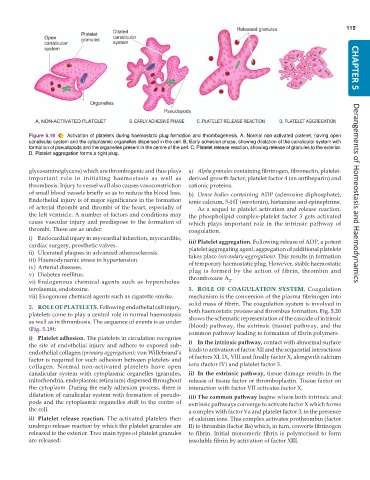
           Figure 5.19  Activation of platelets during haemostatic plug formation and thrombogenesis. A, Normal non-activated platelet, having open
           canalicular system and the cytoplasmic organelles dispersed in the cell. B, Early adhesion phase, showing dilatation of the canalicular system with
           formation of pseudopods and the organelles present in the centre of the cell. C, Platelet release reaction, showing release of granules to the exterior.
           D, Platelet aggregation forms a tight plug.

           glycosaminoglycans) which are thrombogenic and thus plays  a) Alpha granules containing fibrinogen, fibronectin, platelet-
           important role in initiating haemostasis as well as  derived growth factor, platelet factor 4 (an antiheparin) and
           thrombosis. Injury to vessel wall also causes vasoconstriction  cationic proteins.
           of small blood vessels briefly so as to reduce the blood loss.  b) Dense bodies containing ADP (adenosine diphosphate),  Derangements of Homeostasis and Haemodynamics
           Endothelial injury is of major significance in the formation  ionic calcium, 5-HT (serotonin), histamine and epinephrine.
           of arterial thrombi and thrombi of the heart, especially of  As a sequel to platelet activation and release reaction,
           the left ventricle. A number of factors and conditions may  the phospholipid complex-platelet factor 3 gets activated
           cause vascular injury and predispose to the formation of  which plays important role in the intrinsic pathway of
           thrombi. These are as under:                        coagulation.
           i) Endocardial injury in myocardial infarction, myocarditis,  iii) Platelet aggregation. Following release of ADP, a potent
           cardiac surgery, prosthetic valves.                 platelet aggregating agent, aggregation of additional platelets
           ii) Ulcerated plaques in advanced atherosclerosis.  takes place (secondary aggregation). This results in formation
           iii) Haemodynamic stress in hypertension.           of temporary haemostatic plug. However, stable haemostatic
           iv) Arterial diseases.                              plug is formed by the action of fibrin, thrombin and
           v) Diabetes mellitus.                               thromboxane A .
           vi) Endogenous chemical agents such as hypercholes-               2
           terolaemia, endotoxins.                             3. ROLE OF COAGULATION SYSTEM.  Coagulation
           vii) Exogenous chemical agents such as cigarette smoke.  mechanism is the conversion of the plasma fibrinogen into
                                                               solid mass of fibrin. The coagulation system is involved in
           2. ROLE OF PLATELETS. Following endothelial cell injury,  both haemostatic process and thrombus formation. Fig. 5.20
           platelets come to play a central role in normal haemostasis  shows the schematic representation of the cascade of intrinsic
           as well as in thrombosis. The sequence of events is as under  (blood) pathway, the extrinsic (tissue) pathway, and the
           (Fig. 5.19):
                                                               common pathway leading to formation of fibrin polymers.
           i) Platelet adhesion. The platelets in circulation recognise
           the site of endothelial injury and adhere to exposed sub-  i) In the intrinsic pathway, contact with abnormal surface
           endothelial collagen (primary aggregation); von Willebrand’s  leads to activation of factor XII and the sequential interactions
           factor is required for such adhesion between platelets and  of factors XI, IX, VIII and finally factor X, alongwith calcium
           collagen. Normal non-activated platelets have open  ions (factor IV) and platelet factor 3.
           canalicular system with cytoplasmic organelles (granules,  ii) In the extrinsic pathway, tissue damage results in the
           mitochondria, endoplasmic reticulum) dispersed throughout  release of tissue factor or thromboplastin. Tissue factor on
           the cytoplasm. During the early adhesion process, there is  interaction with factor VII activates factor X.
           dilatation of canalicular system with formation of pseudo-  iii) The common pathway begins where both intrinsic and
           pods and the cytoplasmic organelles shift to the centre of  extrinsic pathways converge to activate factor X which forms
           the cell.                                           a complex with factor Va and platelet factor 3, in the presence
           ii) Platelet release reaction. The activated platelets then  of calcium ions. This complex activates prothrombin (factor
           undergo release reaction by which the platelet granules are  II) to thrombin (factor IIa) which, in turn, converts fibrinogen
           released to the exterior. Two main types of platelet granules  to fibrin. Initial monomeric fibrin is polymerised to form
           are released:                                       insoluble fibrin by activation of factor XIII.

