


Page 135 - Textbook of Pathology, 6th Edition
P. 135
119


                                                                                                                      CHAPTER 5


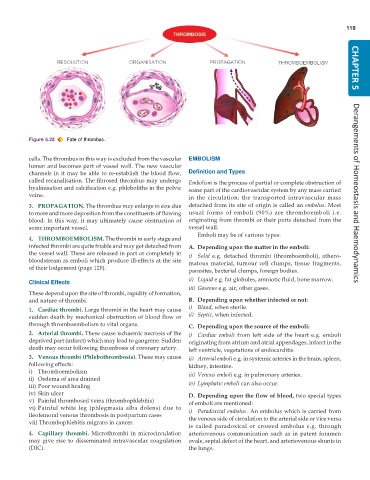
           Figure 5.23  Fate of thrombus.


           cells. The thrombus in this way is excluded from the vascular  EMBOLISM
           lumen and becomes part of vessel wall. The new vascular
           channels in it may be able to re-establish the blood flow,  Definition and Types
           called recanalisation. The fibrosed thrombus may undergo  Embolism is the process of partial or complete obstruction of
           hyalinisation and calcification e.g. phleboliths in the pelvic  some part of the cardiovascular system by any mass carried
           veins.                                              in the circulation; the transported intravascular mass  Derangements of Homeostasis and Haemodynamics
           3. PROPAGATION. The thrombus may enlarge in size due  detached from its site of origin is called an embolus. Most
           to more and more deposition from the constituents of flowing  usual forms of emboli (90%) are thromboemboli i.e.
           blood. In this way, it may ultimately cause obstruction of  originating from thrombi or their parts detached from the
           some important vessel.                              vessel wall.
                                                                  Emboli may be of various types:
           4. THROMBOEMBOLISM. The thrombi in early stage and
           infected thrombi are quite friable and may get detached from  A. Depending upon the matter in the emboli:
           the vessel wall. These are released in part or completely in  i) Solid e.g. detached thrombi (thromboemboli), athero-
           bloodstream as emboli which produce ill-effects at the site  matous material, tumour cell clumps, tissue fragments,
           of their lodgement (page 120).
                                                               parasites, bacterial clumps, foreign bodies.
                                                               ii) Liquid e.g. fat globules, amniotic fluid, bone marrow.
           Clinical Effects
                                                               iii) Gaseous e.g. air, other gases.
           These depend upon the site of thrombi, rapidity of formation,
           and nature of thrombi.                              B. Depending upon whether infected or not:
           1. Cardiac thrombi. Large thrombi in the heart may cause  i) Bland, when sterile.
           sudden death by mechanical obstruction of blood flow or  ii) Septic, when infected.
           through thromboembolism to vital organs.            C. Depending upon the source of the emboli:
           2. Arterial thrombi. These cause ischaemic necrosis of the  i) Cardiac emboli from left side of the heart e.g. emboli
           deprived part (infarct) which may lead to gangrene. Sudden  originating from atrium and atrial appendages, infarct in the
           death may occur following thrombosis of coronary artery.  left ventricle, vegetations of endocarditis.
           3. Venous thrombi (Phlebothrombosis). These may cause  ii) Arterial emboli e.g. in systemic arteries in the brain, spleen,
           following effects:                                  kidney, intestine.
           i) Thromboembolism                                  iii) Venous emboli e.g. in pulmonary arteries.
           ii) Oedema of area drained
           iii) Poor wound healing                             iv) Lymphatic emboli can also occur.
           iv) Skin ulcer                                      D. Depending upon the flow of blood, two special types
           v) Painful thrombosed veins (thrombophlebitis)      of emboli are mentioned:
           vi) Painful white leg (phlegmasia alba dolens) due to  i) Paradoxical embolus. An embolus which is carried from
           ileofemoral venous thrombosis in postpartum cases   the venous side of circulation to the arterial side or vice versa
           vii) Thrombophlebitis migrans in cancer.
                                                               is called paradoxical or crossed embolus e.g. through
           4. Capillary thrombi.  Microthrombi in microcirculation  arteriovenous communication such as in patent foramen
           may give rise to disseminated intravascular coagulation  ovale, septal defect of the heart, and arteriovenous shunts in
           (DIC).                                              the lungs.

