


Page 132 - Textbook of Pathology, 6th Edition
P. 132
116


     SECTION I


     General Pathology and Basic Techniques
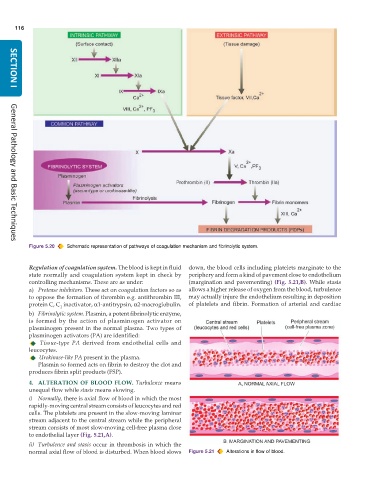
           Figure 5.20  Schematic representation of pathways of coagulation mechanism and fibrinolytic system.

           Regulation of coagulation system. The blood is kept in fluid  down, the blood cells including platelets marginate to the
           state normally and coagulation system kept in check by  periphery and form a kind of pavement close to endothelium
           controlling mechanisms. These are as under:         (margination and pavementing) (Fig. 5.21,B). While stasis
           a) Protease inhibitors. These act on coagulation factors so as  allows a higher release of oxygen from the blood, turbulence
           to oppose the formation of thrombin e.g. antithrombin III,  may actually injure the endothelium resulting in deposition
           protein C, C  inactivator, α1-antitrypsin, α2-macroglobulin.  of platelets and fibrin. Formation of arterial and cardiac
                     1
           b) Fibrinolytic system. Plasmin, a potent fibrinolytic enzyme,
           is formed by the action of plasminogen activator on
           plasminogen present in the normal plasma. Two types of
           plasminogen activators (PA) are identified:
              Tissue-type PA derived from endothelial cells and
           leucocytes.
              Urokinase-like PA present in the plasma.
              Plasmin so formed acts on fibrin to destroy the clot and
           produces fibrin split products (FSP).
           4. ALTERATION OF BLOOD FLOW. Turbulence means
           unequal flow while stasis means slowing.
           i) Normally, there is axial flow of blood in which the most
           rapidly-moving central stream consists of leucocytes and red
           cells. The platelets are present in the slow-moving laminar
           stream adjacent to the central stream while the peripheral
           stream consists of most slow-moving cell-free plasma close
           to endothelial layer (Fig. 5.21,A).
           ii) Turbulence and stasis occur in thrombosis  in which the
           normal axial flow of blood is disturbed. When blood slows  Figure 5.21  Alterations in flow of blood.

