


Page 208 - Textbook of Pathology, 6th Edition
P. 208
192

            Chapter 8
            Chapter 8                                          Neoplasia


             NOMENCLATURE AND CLASSIFICATION                      ‘Parenchyma’ comprised by proliferating tumour cells;
     SECTION I
                                                               parenchyma determines the nature and evolution of the
           INTRODUCTION. The term ‘neoplasia’ means new growth;  tumour.
           the new growth produced is called ‘neoplasm’ or ‘tumour’.  ‘Supportive stroma’ composed of fibrous connective tissue
           However, all ‘new growths’ are not neoplasms since  and blood vessels; it provides the framework on which the
           examples of new growth of tissues and cells also exist in the  parenchymal tumour cells grow.
           processes of embryogenesis, regeneration and repair,   The tumours derive their nomenclature on the basis of
           hyperplasia and hormonal stimulation. The proliferation and  the parenchymal component comprising them. The suffix
           maturation of cells in normal adults is controlled as a result  ‘-oma’ is added to denote benign tumours. Malignant tumours
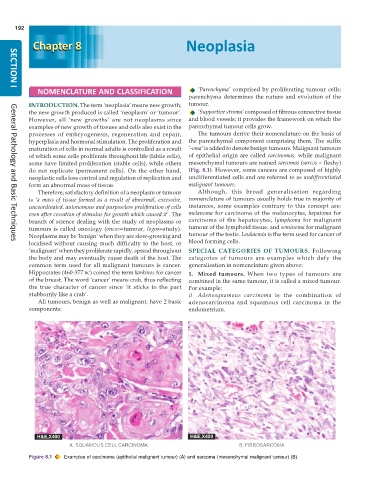
           of which some cells proliferate throughout life (labile cells),  of epithelial origin are called  carcinomas, while malignant
           some have limited proliferation (stable cells), while others  mesenchymal tumours are named sarcomas (sarcos = fleshy)
           do not replicate (permanent cells). On the other hand,  (Fig. 8.1). However, some cancers are composed of highly
           neoplastic cells lose control and regulation of replication and  undifferentiated cells and are referred to as undifferentiated
           form an abnormal mass of tissue.                    malignant tumours.
              Therefore, satisfactory definition of a neoplasm or tumour  Although, this broad generalisation regarding
           is  ‘a mass of tissue formed as a result of abnormal, excessive,  nomenclature of tumours usually holds true in majority of
           uncoordinated, autonomous and purposeless proliferation of cells  instances, some examples contrary to this concept are:
           even after cessation of stimulus for growth which caused it’. The  melanoma for carcinoma of the melanocytes,  hepatoma for
           branch of science dealing with the study of neoplasms or  carcinoma of the hepatocytes,  lymphoma for malignant
           tumours is called oncology (oncos=tumour,  logos=study).  tumour of the lymphoid tissue, and seminoma for malignant
           Neoplasms may be ‘benign’ when they are slow-growing and  tumour of the testis. Leukaemia is the term used for cancer of
           localised without causing much difficulty to the host, or  blood forming cells.
     General Pathology and Basic Techniques
           ‘malignant’ when they proliferate rapidly, spread throughout  SPECIAL CATEGORIES OF TUMOURS. Following
           the body and may eventually cause death of the host. The  categories of tumours are examples which defy the
           common term used for all malignant tumours is cancer.  generalisation in nomenclature given above:
           Hippocrates (460-377 BC) coined the term karkinos for cancer  1. Mixed tumours. When two types of tumours are
           of the breast. The word ‘cancer’ means crab, thus reflecting  combined in the same tumour, it is called a mixed tumour.
           the true character of cancer since ‘it sticks to the part  For example:
           stubbornly like a crab’.                            i) Adenosquamous carcinoma is the combination of
              All tumours, benign as well as malignant, have 2 basic  adenocarcinoma and squamous cell carcinoma in the
           components:                                         endometrium.


           Figure 8.1  Examples of carcinoma (epithelial malignant tumour) (A) and sarcoma (mesenchymal malignant tumour) (B).

