


Page 205 - Textbook of Pathology, 6th Edition
P. 205
189  Infectious and Parasitic Diseases


                                                                                                                      CHAPTER 7


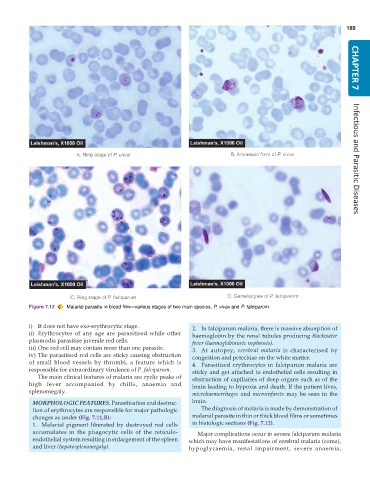
           Figure 7.12  Malarial parasite in blood film—various stages of two main species, P. vivax and P. falciparum.

           i) It does not have exo-erythrocytic stage.           2. In falciparum malaria, there is massive absorption of
           ii) Erythrocytes of any age are parasitised while other  haemoglobin by the renal tubules producing blackwater
           plasmodia parasitise juvenile red cells.              fever (haemoglobinuric nephrosis).
           iii) One red cell may contain more than one parasite.  3. At autopsy,  cerebral malaria is characterised by
           iv) The parasitised red cells are sticky causing obstruction  congestion and petechiae on the white matter.
           of small blood vessels by thrombi, a feature which is  4. Parasitised erythrocytes in falciparum malaria are
           responsible for extraordinary virulence of P. falciparum.  sticky and get attached to endothelial cells resulting in
              The main clinical features of malaria are cyclic peaks of  obstruction of capillaries of deep organs such as of the
           high fever accompanied by chills, anaemia and         brain leading to hypoxia and death. If the patient lives,
           splenomegaly.                                         microhaemorrhages and microinfarcts may be seen in the
            MORPHOLOGIC FEATURES. Parasitisation and destruc-    brain.
            tion of erythrocytes are responsible for major pathologic  The diagnosis of malaria is made by demonstration of
            changes as under (Fig. 7.11,B):                      malarial parasite in thin or thick blood films or sometimes
            1. Malarial pigment liberated by destroyed red cells  in histologic sections (Fig. 7.12).
            accumulates in the phagocytic cells of the reticulo-  Major complications occur in severe falciparum malaria
            endothelial system resulting in enlargement of the spleen  which may have manifestations of cerebral malaria (coma),
            and liver (hepatosplenomegaly).                    hypoglycaemia, renal impairment, severe anaemia,

