


Page 207 - Textbook of Pathology, 6th Edition
P. 207
It has been estimated that TORCH complex infections                                                   191
           have an overall incidence of 1-5% of all live born children.
           All the microorganisms in the TORCH complex are
           transmitted transplacentally and, therefore, infect the foetus
           from the mother. Herpes and cytomegalovirus infections are
           common intrapartum infections acquired venereally.                                                         CHAPTER 7
              Toxoplasmosis is a protozoal infection acquired by
           contact with cat’s faeces or by ingestion of raw uncooked
           meat. Rubella or German measles is teratogenic in pregnant
           mothers. Cytomegalovirus and herpesvirus infection are
           generally transmitted to foetus by chronic carrier mothers.
              An infectious mononucleosis-like disease is present in
           about 10% of mothers whose infants have  Toxoplasma
           infection. Genital herpes infection is present in 20% of
           mothers whose newborn babies suffer from herpes infection.
           Rubella infection during acute stage in the first 10 weeks of
           pregnancy is more harmful to the foetus than at later stage
           of gestation. Symptoms of cytomegalovirus infection are
           present in less than 1% of mothers who display antibodies                                                  Infectious and Parasitic Diseases
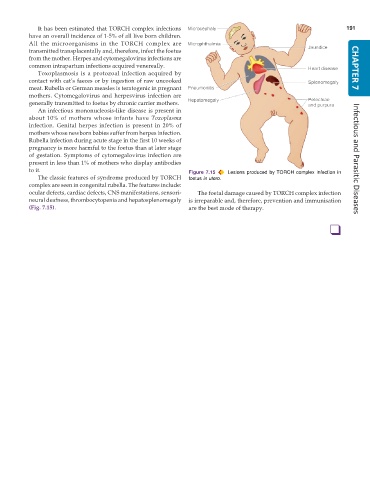
           to it.                                              Figure 7.15  Lesions produced by TORCH complex infection in
              The classic features of syndrome produced by TORCH  foetus in utero.
           complex are seen in congenital rubella. The features include:
           ocular defects, cardiac defects, CNS manifestations, sensori-  The foetal damage caused by TORCH complex infection
           neural deafness, thrombocytopenia and hepatosplenomegaly  is irreparable and, therefore, prevention and immunisation
           (Fig. 7.15).                                        are the best mode of therapy.


                                                                                                              ❑

