


Page 210 - Textbook of Pathology, 6th Edition
P. 210
194 mentioned here that the classification described here is only I. RATE OF GROWTH
a summary. Detailed classifications of benign and malignant The tumour cells generally proliferate more rapidly than the
tumours pertaining to different tissues and body systems normal cells. In general, benign tumours grow slowly and
along with morphologic features of specific tumours appear malignant tumours rapidly. However, there are exceptions
in the specific chapters of Systemic Pathology later.
to this generalisation. The rate at which the tumour enlarges
depends upon 2 main factors:
CHARACTERISTICS OF TUMOURS 1. Rate of cell production, growth fraction and rate of cell
Majority of neoplasms can be categorised clinically and loss
SECTION I
morphologically into benign and malignant on the basis of 2. Degree of differentiation of the tumour.
certain characteristics listed below. However, there are 1. Rate of cell production, growth fraction and rate of cell
exceptions—a small proportion of tumours have some loss. Rate of growth of a tumour depends upon 3 important
features suggesting innocent growth while other features parameters:
point towards a more ominous behaviour. Therefore, it must i) doubling time of tumour cells,
be borne in mind that based characteristics of neoplasms, ii) number of cells remaining in proliferative pool (growth
there is a wide variation in the degree of deviation from the fraction), and
normal in all the tumours. iii) rate of loss of tumour cells by cell shedding.
The characteristics of tumours are described under the In general, malignant tumour cells have increased mitotic
following headings: rate (doubling time) and slower death rate i.e. the cancer cells
I. Rate of growth do not follow normal controls in cell cycle and are immortal.
II. Cancer phenotype and stem cells If the rate of cell division is high, it is likely that tumour cells
III. Clinical and gross features in the centre of the tumour do not receive adequate
IV. Microscopic features nourishment and undergo ischaemic necrosis. At a stage
V. Local invasion (Direct spread) when malignant tumours grow relentlessly, they do so
VI. Metastasis (Distant spread). because a larger proportion of tumour cells remain in
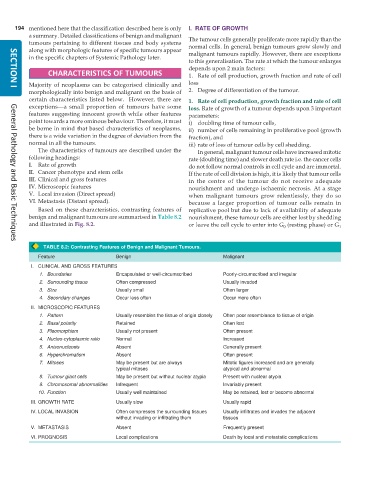
Based on these characteristics, contrasting features of replicative pool but due to lack of availability of adequate
benign and malignant tumours are summarised in Table 8.2 nourishment, these tumour cells are either lost by shedding
and illustrated in Fig. 8.2. or leave the cell cycle to enter into G (resting phase) or G 1
0
General Pathology and Basic Techniques
TABLE 8.2: Contrasting Features of Benign and Malignant Tumours.
Feature Benign Malignant
I. CLINICAL AND GROSS FEATURES
1. Boundaries Encapsulated or well-circumscribed Poorly-circumscribed and irregular
2. Surrounding tissue Often compressed Usually invaded
3. Size Usually small Often larger
4. Secondary changes Occur less often Occur more often
II. MICROSCOPIC FEATURES
1. Pattern Usually resembles the tissue of origin closely Often poor resemblance to tissue of origin
2. Basal polarity Retained Often lost
3. Pleomorphism Usually not present Often present
4. Nucleo-cytoplasmic ratio Normal Increased
5. Anisonucleosis Absent Generally present
6. Hyperchromatism Absent Often present
7. Mitoses May be present but are always Mitotic figures increased and are generally
typical mitoses atypical and abnormal
8. Tumour giant cells May be present but without nuclear atypia Present with nuclear atypia
9. Chromosomal abnormalities Infrequent Invariably present
10. Function Usually well maintained May be retained, lost or become abnormal
III. GROWTH RATE Usually slow Usually rapid
IV. LOCAL INVASION Often compresses the surrounding tissues Usually infiltrates and invades the adjacent
without invading or infiltrating them tissues
V. METASTASIS Absent Frequently present
VI. PROGNOSIS Local complications Death by local and metastatic complications

