


Page 209 - Textbook of Pathology, 6th Edition
P. 209
ii) Adenoacanthoma is the mixture of adenocarcinoma and 3. Blastomas (Embryomas). Blastomas or embryomas are a 193
benign squamous elements in the endometrium. group of malignant tumours which arise from embryonal or
iii) Carcinosarcoma is the rare combination of malignant partially differentiated cells which would normally form
tumour of the epithelium (carcinoma) and of mesenchymal blastema of the organs and tissue during embryogenesis.
tissue (sarcoma) such as in thyroid. These tumours occur more frequently in infants and children
iv) Collision tumour is the term used for morphologically two (under 5 years of age) and include some examples of tumours
different cancers in the same organ which do not mix with in this age group: neuroblastoma, nephroblastoma (Wilms’ CHAPTER 8
each other. tumour), hepatoblastoma, retinoblastoma, medulloblastoma,
v) Mixed tumour of the salivary gland (or pleomorphic pulmonary blastoma.
adenoma) is the term used for benign tumour having 4. Hamartoma. Hamartoma is benign tumour which is made
combination of both epithelial and mesenchymal tissue of mature but disorganised cells of tissues indigenous to the
elements. particular organ e.g. hamartoma of the lung consists of
2. Teratomas. These tumours are made up of a mixture of mature cartilage, mature smooth muscle and epithelium.
various tissue types arising from totipotent cells derived from Thus, all mature differentiated tissue elements which Neoplasia
the three germ cell layers—ectoderm, mesoderm and comprise the bronchus are present in it but are jumbled up
endoderm. Most common sites for teratomas are ovaries and as a mass.
testis (gonadal teratomas). But they occur at extra-gonadal sites 5. Choristoma. Choristoma is the name given to the ectopic
as well, mainly in the midline of the body such as in the head islands of normal tissue. Thus, choristoma is heterotopia but
and neck region, mediastinum, retroperitoneum, is not a true tumour, though it sounds like one.
sacrococcygeal region etc. Teratomas may be benign or mature CLASSIFICATION. Currently, classification of tumours is
(most of the ovarian teratomas) or malignant or immature based on the histogenesis (i.e. cell of origin) and on the
(most of the testicular teratomas).
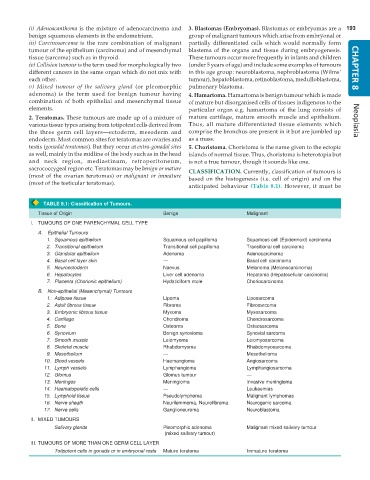
anticipated behaviour (Table 8.1). However, it must be
TABLE 8.1: Classification of Tumours.
Tissue of Origin Benign Malignant
I. TUMOURS OF ONE PARENCHYMAL CELL TYPE
A. Epithelial Tumours
1. Squamous epithelium Squamous cell papilloma Squamous cell (Epidermoid) carcinoma
2. Transitional epithelium Transitional cell papilloma Transitional cell carcinoma
3. Glandular epithelium Adenoma Adenocarcinoma
4. Basal cell layer skin — Basal cell carcinoma
5. Neuroectoderm Naevus Melanoma (Melanocarcinoma)
6. Hepatocytes Liver cell adenoma Hepatoma (Hepatocellular carcinoma)
7. Placenta (Chorionic epithelium) Hydatidiform mole Choriocarcinoma
B. Non-epithelial (Mesenchymal) Tumours
1. Adipose tissue Lipoma Liposarcoma
2. Adult fibrous tissue Fibroma Fibrosarcoma
3. Embryonic fibrous tissue Myxoma Myxosarcoma
4. Cartilage Chondroma Chondrosarcoma
5. Bone Osteoma Osteosarcoma
6. Synovium Benign synovioma Synovial sarcoma
7. Smooth muscle Leiomyoma Leiomyosarcoma
8. Skeletal muscle Rhabdomyoma Rhabdomyosarcoma
9. Mesothelium — Mesothelioma
10. Blood vessels Haemangioma Angiosarcoma
11. Lymph vessels Lymphangioma Lymphangiosarcoma
12. Glomus Glomus tumour —
13. Meninges Meningioma Invasive meningioma
14. Haematopoietic cells — Leukaemias
15. Lymphoid tissue Pseudolymphoma Malignant lymphomas
16. Nerve sheath Neurilemmoma, Neurofibroma Neurogenic sarcoma
17. Nerve cells Ganglioneuroma Neuroblastoma
II. MIXED TUMOURS
Salivary glands Pleomorphic adenoma Malignant mixed salivary tumour
(mixed salivary tumour)
III. TUMOURS OF MORE THAN ONE GERM CELL LAYER
Totipotent cells in gonads or in embryonal rests Mature teratoma Immature teratoma

