


Page 218 - Textbook of Pathology, 6th Edition
P. 218
202


     SECTION I


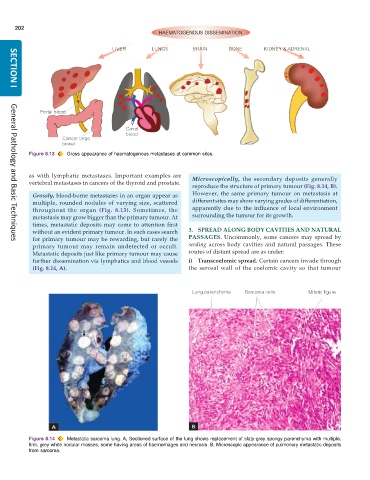
           Figure 8.13  Gross appearance of haematogenous metastases at common sites.


           as with lymphatic metastases. Important examples are  Microscopically, the secondary deposits generally
           vertebral metastases in cancers of the thyroid and prostate.
                                                                 reproduce the structure of primary tumour (Fig. 8.14, B).
            Grossly, blood-borne metastases in an organ appear as  However, the same primary tumour on metastasis at
            multiple, rounded nodules of varying size, scattered  different sites may show varying grades of differentiation,
            throughout the organ  (Fig. 8.13). Sometimes, the    apparently due to the influence of local environment
            metastasis may grow bigger than the primary tumour. At  surrounding the tumour for its growth.
            times, metastatic deposits may come to attention first
            without an evident primary tumour. In such cases search  3. SPREAD ALONG BODY CAVITIES AND NATURAL
            for primary tumour may be rewarding, but rarely the  PASSAGES.  Uncommonly, some cancers may spread by
     General Pathology and Basic Techniques
            primary tumour may remain undetected or occult.    seeding across body cavities and natural passages. These
            Metastatic deposits just like primary tumour may cause  routes of distant spread are as under:
            further dissemination via lymphatics and blood vessels  i) Transcoelomic spread. Certain cancers invade through
            (Fig. 8.14, A).                                    the serosal wall of the coelomic cavity so that tumour


           Figure 8.14  Metastatic sarcoma lung. A, Sectioned surface of the lung shows replacement of slaty-grey spongy parenchyma with multiple,
           firm, grey-white nodular masses, some having areas of haemorhages and necrosis. B, Microscopic appearance of pulmonary metastatic deposits
           from sarcoma.

