


Page 213 - Textbook of Pathology, 6th Edition
P. 213
197


                                                                                                                      CHAPTER 8


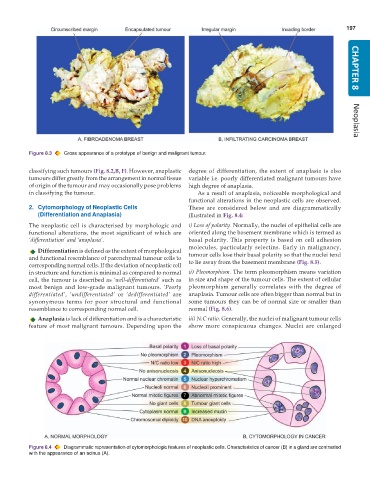
           Figure 8.3  Gross appearance of a prototype of benign and malignant tumour.                                Neoplasia

           classifying such tumours (Fig. 8.2,B, F). However, anaplastic  degree of differentiation, the extent of anaplasia is also
           tumours differ greatly from the arrangement in normal tissue  variable i.e. poorly differentiated malignant tumours have
           of origin of the tumour and may occasionally pose problems  high degree of anaplasia.
           in classifying the tumour.                             As a result of anaplasia, noticeable morphological and
                                                               functional alterations in the neoplastic cells are observed.
           2. Cytomorphology of Neoplastic Cells               These are considered below and are diagrammatically
              (Differentiation and Anaplasia)                  illustrated in Fig. 8.4:
           The neoplastic cell is characterised by morphologic and  i) Loss of polarity. Normally, the nuclei of epithelial cells are
           functional alterations, the most significant of which are  oriented along the basement membrane which is termed as
           ‘differentiation’ and ‘anaplasia’.                  basal polarity. This property is based on cell adhesion
                                                               molecules, particularly selectins. Early in malignancy,
              Differentiation is defined as the extent of morphological
           and functional resemblance of parenchymal tumour cells to  tumour cells lose their basal polarity so that the nuclei tend
           corresponding normal cells. If the deviation of neoplastic cell  to lie away from the basement membrane (Fig. 8.5).
           in structure and function is minimal as compared to normal  ii) Pleomorphism. The term pleomorphism means variation
           cell, the tumour is described as ‘well-differentiated’ such as  in size and shape of the tumour cells. The extent of cellular
           most benign and low-grade malignant tumours.  ‘Poorly  pleomorphism generally correlates with the degree of
           differentiated’, ‘undifferentiated’ or  ‘dedifferentiated’ are  anaplasia. Tumour cells are often bigger than normal but in
           synonymous terms for poor structural and functional  some tumours they can be of normal size or smaller than
           resemblance to corresponding normal cell.           normal (Fig. 8.6).
              Anaplasia is lack of differentiation and is a characteristic  iii) N:C ratio. Generally, the nuclei of malignant tumour cells
           feature of most malignant tumours. Depending upon the  show more conspicuous changes. Nuclei are enlarged


           Figure 8.4  Diagrammatic representation of cytomorphologic features of neoplastic cells. Characteristics of cancer (B) in a gland are contrasted
           with the appearance of an acinus (A).

