


Page 310 - Textbook of Pathology, 6th Edition
P. 310
294 erythropoietic activity. In acute haemorrhage and in A. Cytoplasmic maturation defects
haemolysis, the reticulocyte response is indicative of 1. Deficient haem synthesis: iron deficiency anaemia
impaired marrow function. 2. Deficient globin synthesis: thalassaemic syndromes
F. ERYTHROCYTE SEDIMENTATION RATE. The ESR B. Nuclear maturation defects
is a non-specific test used as a screening test for anaemia. It Vitamin B and/or folic acid deficiency: megalo-
12
usually gives a clue to the underlying organic disease but blastic anaemia
anaemia itself may also cause rise in the ESR.
C. Haematopoietic stem cell proliferation and differentiation
G. BONE MARROW EXAMINATION. Bone marrow abnormality e.g.
aspiration is done in cases where the cause for anaemia is 1. Aplastic anaemia
not obvious. The procedures involved for marrow aspiration 2. Pure red cell aplasia
and trephine biopsy and their relative advantages and D. Bone marrow failure due to systemic diseases (anaemia of
disadvantages have already been discussed (page 285). chronic disorders) e.g.
In addition to these general tests, certain specific tests 1. Anaemia of inflammation/infections, disseminated
are done in different types of anaemias which are described malignancy
later under the discussion of specific anaemias. 2. Anaemia in renal disease
3. Anaemia due to endocrine and nutritional deficiencies
Classification of Anaemias (hypometabolic states)
Several types of classifications of anaemias have been 4. Anaemia in liver disease
SECTION II
proposed. Two of the widely accepted classifications are E. Bone marrow infiltration e.g.
based on the pathophysiology and morphology (Table 12.3). 1. Leukaemias
2. Lymphomas
PATHOPHYSIOLOGIC CLASSIFICATION. Depending 3. Myelosclerosis
upon the pathophysiologic mechanism, anaemias are 4. Multiple myeloma
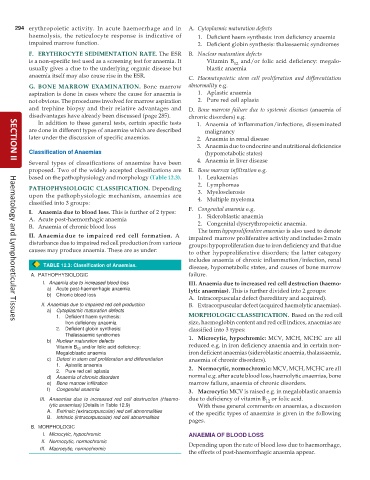
classified into 3 groups:
F. Congenital anaemia e.g.
I. Anaemia due to blood loss. This is further of 2 types:
A. Acute post-haemorrhagic anaemia 1. Sideroblastic anaemia
B. Anaemia of chronic blood loss 2. Congenital dyserythropoietic anaemia.
The term hypoproliferative anaemias is also used to denote
II. Anaemia due to impaired red cell formation. A impaired marrow proliferative activity and includes 2 main
disturbance due to impaired red cell production from various groups: hypoproliferation due to iron deficiency and that due
causes may produce anaemia. These are as under: to other hypoproliferative disorders; the latter category
includes anaemia of chronic inflammation/infection, renal
TABLE 12.3: Classification of Anaemias. disease, hypometabolic states, and causes of bone marrow
A. PATHOPHYSIOLOGIC failure.
I. Anaemia due to increased blood loss III. Anaemia due to increased red cell destruction (haemo-
a) Acute post-haemorrhagic anaemia lytic anaemias). This is further divided into 2 groups:
b) Chronic blood loss
A. Intracorpuscular defect (hereditary and acquired).
II. Anaemias due to impaired red cell production B. Extracorpuscular defect (acquired haemolytic anaemias).
a) Cytoplasmic maturation defects
1. Deficient haem synthesis: MORPHOLOGIC CLASSIFICATION. Based on the red cell
Iron deficiency anaemia size, haemoglobin content and red cell indices, anaemias are
Haematology and Lymphoreticular Tissues
2. Deficient globin synthesis: classified into 3 types:
Thalassaemic syndromes 1. Microcytic, hypochromic: MCV, MCH, MCHC are all
b) Nuclear maturation defects
Vitamin B and/or folic acid deficiency: reduced e.g. in iron deficiency anaemia and in certain non-
12
Megaloblastic anaemia iron deficient anaemias (sideroblastic anaemia, thalassaemia,
c) Defect in stem cell proliferation and differentiation anaemia of chronic disorders).
1. Aplastic anaemia 2. Normocytic, normochromic: MCV, MCH, MCHC are all
2. Pure red cell aplasia
d) Anaemia of chronic disorders normal e.g. after acute blood loss, haemolytic anaemias, bone
e) Bone marrow infiltration marrow failure, anaemia of chronic disorders.
f) Congenital anaemia 3. Macrocytic: MCV is raised e.g. in megaloblastic anaemia
III. Anaemias due to increased red cell destruction (Haemo- due to deficiency of vitamin B or folic acid.
12
lytic anaemias) (Details in Table 12.9) With these general comments on anaemias, a discussion
A. Extrinsic (extracorpuscular) red cell abnormalities of the specific types of anaemias is given in the following
B. Intrinsic (intracorpuscular) red cell abnormalities
pages.
B. MORPHOLOGIC
I. Microcytic, hypochromic ANAEMIA OF BLOOD LOSS
II. Normocytic, normochromic Depending upon the rate of blood loss due to haemorrhage,
III. Macrocytic, normochromic
the effects of post-haemorrhagic anaemia appear.

