


Page 312 - Textbook of Pathology, 6th Edition
P. 312
296


     SECTION II


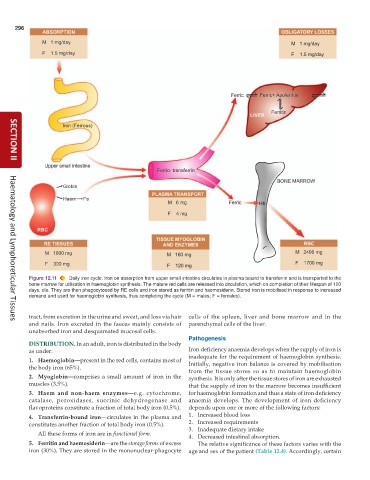
           Figure 12.11  Daily iron cycle. Iron on absorption from upper small intestine circulates in plasma bound to transferrin and is transported to the
           bone marrow for utilisation in haemoglobin synthesis. The mature red cells are released into circulation, which on completion of their lifespan of 120
           days, die. They are then phagocytosed by RE cells and iron stored as ferritin and haemosiderin. Stored iron is mobilised in response to increased
           demand and used for haemoglobin synthesis, thus completing the cycle (M = males; F = females).


           tract, from excretion in the urine and sweat, and loss via hair  cells of the spleen, liver and bone marrow and in the
           and nails. Iron excreted in the faeces mainly consists of  parenchymal cells of the liver.
     Haematology and Lymphoreticular Tissues
           unabsorbed iron and desquamated mucosal cells.
                                                               Pathogenesis
           DISTRIBUTION. In an adult, iron is distributed in the body
           as under:                                           Iron deficiency anaemia develops when the supply of iron is
                                                               inadequate for the requirement of haemoglobin synthesis.
           1. Haemoglobin—present in the red cells, contains most of  Initially, negative iron balance is covered by mobilisation
           the body iron (65%).                                from the tissue stores so as to maintain haemoglobin
           2. Myoglobin—comprises a small amount of iron in the  synthesis. It is only after the tissue stores of iron are exhausted
           muscles (3.5%).                                     that the supply of iron to the marrow becomes insufficient
           3. Haem  and non-haem enzymes—e.g. cytochrome,      for haemoglobin formation and thus a state of iron deficiency
           catalase, peroxidases, succinic dehydrogenase and   anaemia develops. The development of iron deficiency
           flavoproteins constitute a fraction of total body iron (0.5%).  depends upon one or more of the following factors:
           4. Transferrin-bound iron—circulates in the plasma and  1. Increased blood loss
           constitutes another fraction of total body iron (0.5%).  2. Increased requirements
                                                               3. Inadequate dietary intake
              All these forms of iron are in functional form.
                                                               4. Decreased intestinal absorption.
           5. Ferritin and haemosiderin—are the storage forms of excess  The relative significance of these factors varies with the
           iron (30%). They are stored in the mononuclear-phagocyte  age and sex of the patient (Table 12.4). Accordingly, certain

