


Page 326 - Textbook of Pathology, 6th Edition
P. 326
310


     SECTION II

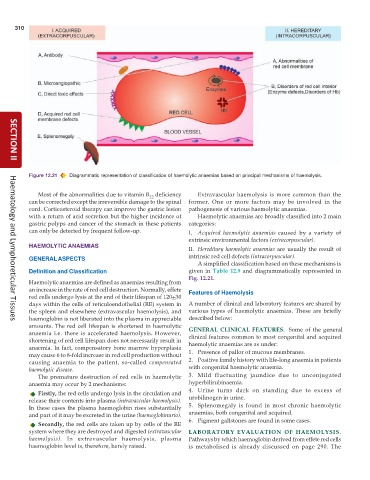
           Figure 12.21  Diagrammatic representation of classification of haemolytic anaemias based on principal mechanisms of haemolysis.

              Most of the abnormalities due to vitamin B  deficiency  Extravascular haemolysis is more common than the
                                                  12
           can be corrected except the irreversible damage to the spinal  former. One or more factors may be involved in the
           cord. Corticosteroid therapy can improve the gastric lesion  pathogenesis of various haemolytic anaemias.
           with a return of acid secretion but the higher incidence of  Haemolytic anaemias are broadly classified into 2 main
           gastric polyps and cancer of the stomach in these patients  categories:
           can only be detected by frequent follow-up.         I. Acquired haemolytic anaemias caused by a variety of
                                                               extrinsic environmental factors (extracorpuscular).
           HAEMOLYTIC ANAEMIAS
                                                               II. Hereditary haemolytic anaemias are usually the result of
           GENERAL ASPECTS                                     intrinsic red cell defects (intracorpuscular).
                                                                  A simplified classification based on these mechanisms is
           Definition and Classification                       given in  Table 12.9 and diagrammatically represented in
                                                               Fig. 12.21.
           Haemolytic anaemias are defined as anaemias resulting from
           an increase in the rate of red cell destruction. Normally, effete  Features of Haemolysis
           red cells undergo lysis at the end of their lifespan of 120+30
           days within the cells of reticuloendothelial (RE) system in  A number of clinical and laboratory features are shared by
           the spleen and elsewhere (extravascular haemolysis), and  various types of haemolytic anaemias. These are briefly
           haemoglobin is not liberated into the plasma in appreciable  described below:
     Haematology and Lymphoreticular Tissues
           amounts. The red cell lifespan is shortened in haemolytic  GENERAL CLINICAL FEATURES.   Some of the general
           anaemia i.e. there is accelerated haemolysis. However,  clinical features common to most congenital and acquired
           shortening of red cell lifespan does not necessarily result in  haemolytic anaemias are as under:
           anaemia. In fact, compensatory bone marrow hyperplasia
           may cause 6 to 8-fold increase in red cell production without  1. Presence of pallor of mucous membranes.
           causing anaemia to the patient, so-called  compensated  2. Positive family history with life-long anaemia in patients
                                                               with congenital haemolytic anaemia.
           haemolytic disease.
              The premature destruction of red cells in haemolytic  3. Mild fluctuating jaundice due to unconjugated
           anaemia may occur by 2 mechanisms:                  hyperbilirubinaemia.
                                                               4. Urine turns dark on standing due to excess of
              Firstly, the red cells undergo lysis in the circulation and
           release their contents into plasma (intravascular haemolysis).  urobilinogen in urine.
           In these cases the plasma haemoglobin rises substantially  5. Splenomegaly is found in most chronic haemolytic
           and part of it may be excreted in the urine (haemoglobinuria).  anaemias, both congenital and acquired.
                                                               6. Pigment gallstones are found in some cases.
              Secondly, the red cells are taken up by cells of the RE
           system where they are destroyed and digested (extravascular  LABORATORY  EVALUATION OF HAEMOLYSIS.
           haemolysis). In extravascular haemolysis, plasma    Pathways by which haemoglobin derived from effete red cells
           haemoglobin level is, therefore, barely raised.     is metabolised is already discussed on page 290. The

