


Page 322 - Textbook of Pathology, 6th Edition
P. 322
306 malabsorption, excess folate utilisation such as in pregnancy  4. Others. In addition to the cardinal features mentioned
           and in various disease states, chronic alcoholism, and excess  above, patients may have various other symptoms. These
           urinary folate loss. Folate deficiency arises more rapidly than  include: mild jaundice, angular stomatitis, purpura, melanin
           vitamin B  deficiency since the body’s stores of folate are  pigmentation, symptoms of malabsorption, weight loss and
                   12
           relatively low which can last for up to 4 months only.  anorexia.
              Patients with tropical sprue are often deficient in both
           vitamin B  and folate. Combined deficiency of vitamin B 12  Laboratory Findings
                   12
           and folate may occur from severe deficiency of vitamin B 12  The investigations of a suspected case of megaloblastic
           because of the biochemical interrelationship with folate  anaemia are aimed at 2 aspects:
           metabolism.                                           A. General laboratory investigations of anaemia which include
           3. OTHER CAUSES. In addition to deficiency of vitamin  blood picture, red cell indices, bone marrow findings, and
           B  and folate, megaloblastic anaemias may occasionally be  biochemical tests.
            12
           induced by other factors unrelated to vitamin deficiency.  B. Special tests to establish the cause of megaloblastic anaemia
           These include many drugs which interfere with DNA     as to know whether it is due to deficiency of vitamin B 12
           synthesis, acquired defects of haematopoietic stem cells, and  or folate.
           rarely, congenital enzyme deficiencies.                Based on these principles, the following scheme of
                                                                 investigations is followed:
           Clinical Features
                                                                 A. General Laboratory Findings
           Deficiency of vitamin B  and folate may cause following
     SECTION II
                               12
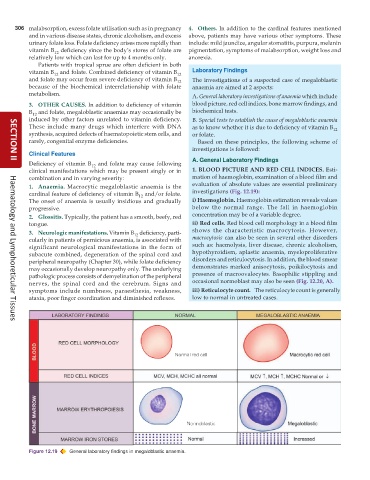
           clinical manifestations which may be present singly or in  1. BLOOD PICTURE AND RED CELL INDICES. Esti-
           combination and in varying severity:                  mation of haemoglobin, examination of a blood film and
           1. Anaemia.  Macrocytic megaloblastic anaemia is the  evaluation of absolute values are essential preliminary
           cardinal feature of deficiency of vitamin B  and/or folate.  investigations (Fig. 12.19):
                                               12
           The onset of anaemia is usually insidious and gradually  i) Haemoglobin. Haemoglobin estimation reveals values
           progressive.                                          below the normal range. The fall in haemoglobin
           2. Glossitis. Typically, the patient has a smooth, beefy, red  concentration may be of a variable degree.
           tongue.                                               ii) Red cells. Red blood cell morphology in a blood film
           3. Neurologic manifestations. Vitamin B  deficiency, parti-  shows the characteristic macrocytosis. However,
                                             12
           cularly in patients of pernicious anaemia, is associated with  macrocytosis can also be seen in several other disorders
           significant neurological manifestations in the form of  such as: haemolysis, liver disease, chronic alcoholism,
           subacute combined, degeneration of the spinal cord and  hypothyroidism, aplastic anaemia, myeloproliferative
           peripheral neuropathy (Chapter 30), while folate deficiency  disorders and reticulocytosis. In addition, the blood smear
           may occasionally develop neuropathy only. The underlying  demonstrates marked anisocytosis, poikilocytosis and
           pathologic process consists of demyelination of the peripheral  presence of macroovalocytes. Basophilic stippling and
           nerves, the spinal cord and the cerebrum. Signs and   occasional normoblast may also be seen (Fig. 12.20, A).
           symptoms include numbness, paraesthesia, weakness,    iii) Reticulocyte count.  The reticulocyte count is generally
           ataxia, poor finger coordination and diminished reflexes.  low to normal in untreated cases.


     Haematology and Lymphoreticular Tissues


           Figure 12.19  General laboratory findings in megaloblastic anaemia.

