


Page 321 - Textbook of Pathology, 6th Edition
P. 321
absence of natural inhibitors. Mono- and diglutamates with the synthesis of DNA. Deficiency of vitamin B traps 305
12
undergo further reduction in the mucosal cells to form folate as its transport form, methyl-THF, thereby resulting
tetrahydrofolate (THF), a monoglutamate. THF circulates in in reduced formation of the active form, methylene-THF,
the plasma as methylated compound, methyl THF, bound needed for DNA synthesis. This is referred to as methyl-folate
to a protein. Once methyl THF is transported into the cell by trap hypothesis. An alternative hypothesis of inter-relationship
a carrier protein, it is reconverted to polyglutamate (see of B and folate is the formate-saturation hypothesis. According
12
Fig. 12.12,C). to this hypothesis, the active substrate is formyl-THF.
Vitamin B deficiency results in reduced supply of formate
12
TISSUE STORES. The liver and red cells are the main storage to THF causing reduced generation of the active compound,
sites of folate, largely as methyl THF polyglutamate form. formyl THF.
The total body stores of folate are about 10-12 mg enough
for about 4 months. Normally, folate is lost from the sweat, Etiology and Classification of Megaloblastic Anaemia
saliva, urine and faeces.
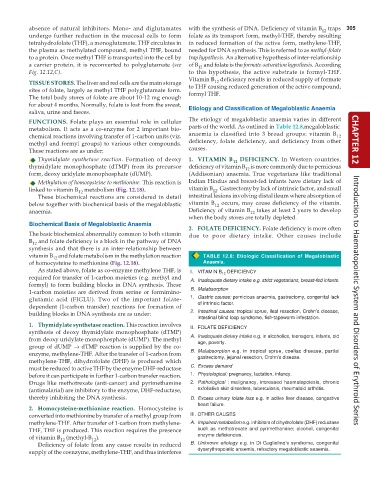
FUNCTIONS. Folate plays an essential role in cellular The etiology of megaloblastic anaemia varies in different
metabolism. It acts as a co-enzyme for 2 important bio- parts of the world. As outlined in Table 12.8,megaloblastic
chemical reactions involving transfer of 1-carbon units (viz. anaemia is classified into 3 broad groups: vitamin B 12
methyl and formyl groups) to various other compounds. deficiency, folate deficiency, and deficiency from other CHAPTER 12
These reactions are as under: causes.
Thymidylate synthetase reaction. Formation of deoxy 1. VITAMIN B DEFICIENCY. In Western countries,
12
thymidylate monophosphate (dTMP) from its precursor deficiency of vitamin B is more commonly due to pernicious
12
form, deoxy uridylate monophosphate (dUMP). (Addisonian) anaemia. True vegetarians like traditional
Methylation of homocysteine to methionine. This reaction is Indian Hindus and breast-fed infants have dietary lack of
linked to vitamin B metabolism (Fig. 12.18). vitamin B . Gastrectomy by lack of intrinsic factor, and small
12
12
These biochemical reactions are considered in detail intestinal lesions involving distal ileum where absorption of
below together with biochemical basis of the megaloblastic vitamin B occurs, may cause deficiency of the vitamin.
12
anaemia. Deficiency of vitamin B takes at least 2 years to develop
12
when the body stores are totally depleted.
Biochemical Basis of Megaloblastic Anaemia
2. FOLATE DEFICIENCY. Folate deficiency is more often
The basic biochemical abnormality common to both vitamin due to poor dietary intake. Other causes include
B and folate deficiency is a block in the pathway of DNA
12
synthesis and that there is an inter-relationship between
vitamin B and folate metabolism in the methylation reaction TABLE 12.8: Etiologic Classification of Megaloblastic
12
of homocysteine to methionine (Fig. 12.18). Anaemia.
As stated above, folate as co-enzyme methylene THF, is I. VITAMIN B 12 DEFICIENCY
required for transfer of 1-carbon moieties (e.g. methyl and A. Inadequate dietary intake e.g. strict vegetarians, breast-fed infants.
formyl) to form building blocks in DNA synthesis. These
1-carbon moieties are derived from serine or formimino- B. Malabsorption
glutamic acid (FIGLU). Two of the important folate- 1. Gastric causes: pernicious anaemia, gastrectomy, congenital lack Introduction to Haematopoietic System and Disorders of Erythroid Series
dependent (1-carbon transfer) reactions for formation of of intrinsic factor.
building blocks in DNA synthesis are as under: 2. Intestinal causes: tropical sprue, ileal resection, Crohn’s disease,
intestinal blind loop syndrome, fish-tapeworm infestation.
1. Thymidylate synthetase reaction. This reaction involves II. FOLATE DEFICIENCY
synthesis of deoxy thymidylate monophosphate (dTMP)
from deoxy uridylate monophosphate (dUMP). The methyl A. Inadequate dietary intake e.g. in alcoholics, teenagers, infants, old
age, poverty.
group of dUMP → dTMP reaction is supplied by the co-
enzyme, methylene-THF. After the transfer of 1-carbon from B. Malabsorption e.g. in tropical sprue, coeliac disease, partial
methylene-THF, dihydrofolate (DHF) is produced which gastrectomy, jejunal resection, Crohn’s disease.
must be reduced to active THF by the enzyme DHF-reductase C. Excess demand
before it can participate in further 1-carbon transfer reaction. 1. Physiological: pregnancy, lactation, infancy.
Drugs like methotrexate (anti-cancer) and pyrimethamine 2. Pathological : malignancy, increased haematopoiesis, chronic
(antimalarial) are inhibitory to the enzyme, DHF-reductase, exfoliative skin disorders, tuberculosis, rheumatoid arthritis.
thereby inhibiting the DNA synthesis. D. Excess urinary folate loss e.g. in active liver disease, congestive
heart failure.
2. Homocysteine-methionine reaction. Homocysteine is
converted into methionine by transfer of a methyl group from III. OTHER CAUSES
methylene-THF. After transfer of 1-carbon from methylene- A. Impaired metabolism e.g. inhibitors of dihydrofolate (DHF) reductase
THF, THF is produced. This reaction requires the presence such as methotrexate and pyrimethamine; alcohol, congenital
of vitamin B (methyl-B ). enzyme deficiencies.
12
12
Deficiency of folate from any cause results in reduced B. Unknown etiology e.g. in Di Guglielmo’s syndrome, congenital
supply of the coenzyme, methylene-THF, and thus interferes dyserythropoietic anaemia, refractory megaloblastic anaemia.

