


Page 330 - Textbook of Pathology, 6th Edition
P. 330
314                                                        ii) Pancytopenia (mild granulocytopenia and thrombo-
                                                                 cytopenia frequent).
                                                                 iii) Intermittent clinical haemoglobinuria; acute haemo-
                                                                 lytic episodes occur at night identified by passage of
                                                                 brown urine in the morning.
                                                                 iv) Haemosiderinuria very common.
                                                                 v) Venous thrombosis as a common complication.
                                                                  The presence of inordinate sensitivity of red blood cells,
                                                                 leucocytes and platelets to complement in PNH can be
                                                                 demonstrated in vitro by Ham’s test using red cell lysis at
                                                                 acidic pH or by sucrose haemolysis test.
                                                                  About 20% cases of PNH may develop myeloproli-
                                                                 ferative or myelodysplastic disorder and some even
                                                                 develop acute myeloid leukaemia.

                                                               E. HAEMOLYTIC ANAEMIA IN SPLENOMEGALY
                                                               Haemolytic anaemia is common in splenic enlargement from
     SECTION II
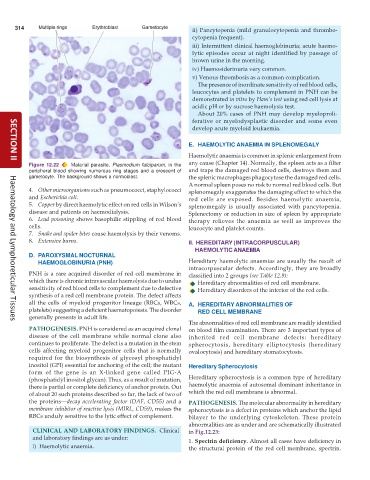
           Figure 12.22  Malarial parasite,  Plasmodium falciparum, in the  any cause (Chapter 14). Normally, the spleen acts as a filter
           peripheral blood showing numerous ring stages and a crescent of  and traps the damaged red blood cells, destroys them and
           gametocyte. The background shows a normoblast.      the splenic macrophages phagocytose the damaged red cells.
                                                               A normal spleen poses no risk to normal red blood cells. But
           4. Other microorganisms such as pneumococci, staphylococci  splenomegaly exaggerates the damaging effect to which the
           and Escherichia coli.                               red cells are exposed. Besides haemolytic anaemia,
           5. Copper by direct haemolytic effect on red cells in Wilson’s  splenomegaly is usually associated with pancytopenia.
           disease and patients on haemodialysis.              Splenectomy or reduction in size of spleen by appropriate
           6. Lead poisoning shows basophilic stippling of red blood  therapy relieves the anaemia as well as improves the
           cells.                                              leucocyte and platelet counts.
           7. Snake and spider bites cause haemolysis by their venoms.
           8. Extensive burns.                                 II. HEREDITARY (INTRACORPUSCULAR)
                                                                   HAEMOLYTIC ANAEMIA
           D. PAROXYSMAL NOCTURNAL
              HAEMOGLOBINURIA (PNH)                            Hereditary haemolytic anaemias are usually the result of
                                                               intracorpuscular defects. Accordingly, they are broadly
           PNH is a rare acquired disorder of red cell membrane in  classified into 2 groups (see Table 12.9):
           which there is chronic intravascular haemolysis due to undue  Hereditary abnormalities of red cell membrane.
           sensitivity of red blood cells to complement due to defective  Hereditary disorders of the interior of the red cells.
           synthesis of a red cell membrane protein. The defect affects
           all the cells of myeloid progenitor lineage (RBCs, WBCs,  A. HEREDITARY ABNORMALITIES OF
           platelets) suggesting a deficient haematopoiesis. The disorder  RED CELL MEMBRANE
           generally presents in adult life.
                                                               The abnormalities of red cell membrane are readily identified
     Haematology and Lymphoreticular Tissues
           PATHOGENESIS. PNH is considered as an acquired clonal  on blood film examination. There are 3 important types of
           disease of the cell membrane while normal clone also  inherited red cell membrane defects: hereditary
           continues to proliferate. The defect is a mutation in the stem  spherocytosis, hereditary elliptocytosis (hereditary
           cells affecting myeloid progenitor cells that is normally  ovalocytosis) and hereditary stomatocytosis.
           required for the biosynthesis of glycosyl phosphatidyl
           inositol (GPI) essential for anchoring of the cell; the mutant  Hereditary Spherocytosis
           form of the gene is an X-linked gene called PIG-A
           (phosphatidyl inositol glycan). Thus, as a result of mutation,  Hereditary spherocytosis is a common type of hereditary
           there is partial or complete deficiency of anchor protein. Out  haemolytic anaemia of autosomal dominant inheritance in
           of about 20 such proteins described so far, the lack of two of  which the red cell membrane is abnormal.
           the proteins—decay accelerating factor (DAF, CD55) and a  PATHOGENESIS. The molecular abnormality in hereditary
           membrane inhibitor of reactive lysis (MIRL, CD59), makes the  spherocytosis is a defect in proteins which anchor the lipid
           RBCs unduly sensitive to the lytic effect of complement.  bilayer to the underlying cytoskeleton. These protein
                                                               abnormalities are as under and are schematically illustrated
            CLINICAL AND LABORATORY FINDINGS.  Clinical        in Fig.12.23:
            and laboratory findings are as under:              1. Spectrin deficiency. Almost all cases have deficiency in
            i)  Haemolytic anaemia.                            the structural protein of the red cell membrane, spectrin.

