


Page 341 - Textbook of Pathology, 6th Edition
P. 341
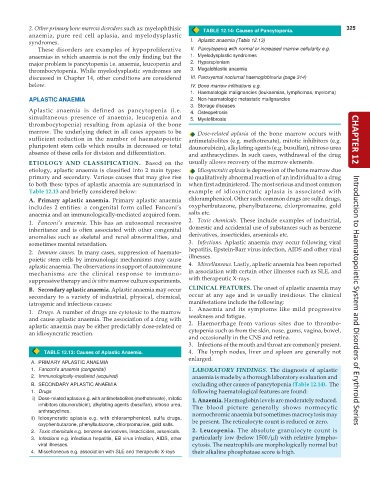
2. Other primary bone marrow disroders such as: myelophthisic TABLE 12.14: Causes of Pancytopenia. 325
anaemia, pure red cell aplasia, and myelodysplastic
syndromes. I. Aplastic anaemia (Table 12.13)
These disorders are examples of hypoproliferative II. Pancytopenia with normal or increased marrow cellularity e.g.
anaemias in which anaemia is not the only finding but the 1. Myelodysplastic syndromes
major problem is pancytopenia i.e. anaemia, leucopenia and 2. Hypersplenism
thrombocytopenia. While myelodysplastic syndromes are 3. Megaloblastic anaemia
discussed in Chapter 14, other conditions are considered III. Paroxysmal nocturnal haemoglobinuria (page 314)
below. IV. Bone marrow infiltrations e.g.
1. Haematologic malignancies (leukaemias, lymphomas, myeloma)
APLASTIC ANAEMIA 2. Non-haematologic metastatic malignancies
3. Storage diseases
Aplastic anaemia is defined as pancytopenia (i.e. 4. Osteopetrosis
simultaneous presence of anaemia, leucopenia and 5. Myelofibrosis
thrombocytopenia) resulting from aplasia of the bone
marrow. The underlying defect in all cases appears to be Dose-related aplasia of the bone marrow occurs with
sufficient reduction in the number of haematopoietic antimetabolites (e.g. methotrexate), mitotic inhibitors (e.g. CHAPTER 12
pluripotent stem cells which results in decreased or total daunorubicin), alkylating agents (e.g. busulfan), nitroso urea
absence of these cells for division and differentiation. and anthracyclines. In such cases, withdrawal of the drug
ETIOLOGY AND CLASSIFICATION. Based on the usually allows recovery of the marrow elements.
etiology, aplastic anaemia is classified into 2 main types: Idiosyncratic aplasia is depression of the bone marrow due
primary and secondary. Various causes that may give rise to qualitatively abnormal reaction of an individual to a drug
to both these types of aplastic anaemia are summarised in when first administered. The most serious and most common
Table 12.13 and briefly considered below: example of idiosyncratic aplasia is associated with
A. Primary aplastic anaemia. Primary aplastic anaemia chloramphenicol. Other such common drugs are sulfa drugs,
includes 2 entities: a congenital form called Fanconi’s oxyphenbutazone, phenylbutazone, chlorpromazine, gold
anaemia and an immunologically-mediated acquired form. salts etc.
1. Fanconi’s anaemia. This has an autosomal recessive 2. Toxic chemicals. These include examples of industrial,
inheritance and is often associated with other congenital domestic and accidental use of substances such as benzene
anomalies such as skeletal and renal abnormalities, and derivatives, insecticides, arsenicals etc.
sometimes mental retardation. 3. Infections. Aplastic anaemia may occur following viral
2. Immune causes. In many cases, suppression of haemato- hepatitis, Epstein-Barr virus infection, AIDS and other viral
poietic stem cells by immunologic mechanisms may cause illnesses.
aplastic anaemia. The observations in support of autoimmune 4. Miscellaneous. Lastly, aplastic anaemia has been reported
mechanisms are the clinical response to immuno- in association with certain other illnesses such as SLE, and
suppressive therapy and in vitro marrow culture experiments. with therapeutic X-rays.
B. Secondary aplastic anaemia. Aplastic anaemia may occur CLINICAL FEATURES. The onset of aplastic anaemia may
secondary to a variety of industrial, physical, chemical, occur at any age and is usually insidious. The clinical
iatrogenic and infectious causes: manifestations include the following: Introduction to Haematopoietic System and Disorders of Erythroid Series
1. Drugs. A number of drugs are cytotoxic to the marrow 1. Anaemia and its symptoms like mild progressive
and cause aplastic anaemia. The association of a drug with weakness and fatigue.
aplastic anaemia may be either predictably dose-related or 2. Haemorrhage from various sites due to thrombo-
an idiosyncratic reaction. cytopenia such as from the skin, nose, gums, vagina, bowel,
and occasionally in the CNS and retina.
3. Infections of the mouth and throat are commonly present.
TABLE 12.13: Causes of Aplastic Anaemia. 4. The lymph nodes, liver and spleen are generally not
enlarged.
A. PRIMARY APLASTIC ANAEMIA
1. Fanconi’s anaemia (congenital) LABORATORY FINDINGS. The diagnosis of aplastic
2. Immunologically-mediated (acquired) anaemia is made by a thorough laboratory evaluation and
B. SECONDARY APLASTIC ANAEMIA excluding other causes of pancytopenia (Table 12.14). The
1. Drugs following haematological features are found:
i) Dose-related aplasia e.g. with antimetabolites (methotrexate), mitotic 1. Anaemia. Haemoglobin levels are moderately reduced.
inhibitors (daunorubicin), alkylating agents (busulfan), nitroso urea, The blood picture generally shows normocytic
anthracyclines. normochromic anaemia but sometimes macrocytosis may
ii) Idiosyncratic aplasia e.g. with chloramphenicol, sulfa drugs, be present. The reticulocyte count is reduced or zero.
oxyphenbutazone, phenylbutazone, chlorpromazine, gold salts.
2. Toxic chemicals e.g. benzene derivatives, insecticides, arsenicals. 2. Leucopenia. The absolute granulocyte count is
3. Infections e.g. infectious hepatitis, EB virus infection, AIDS, other particularly low (below 1500/μl) with relative lympho-
viral illnesses. cytosis. The neutrophils are morphologically normal but
4. Miscellaneous e.g. association with SLE and therapeutic X-rays their alkaline phosphatase score is high.

