


Page 342 - Textbook of Pathology, 6th Edition
P. 342
326   3.Thrombocytopenia.  Platelet count is always reduced.  marrow transplantation are: acute leukaemias—AML in first
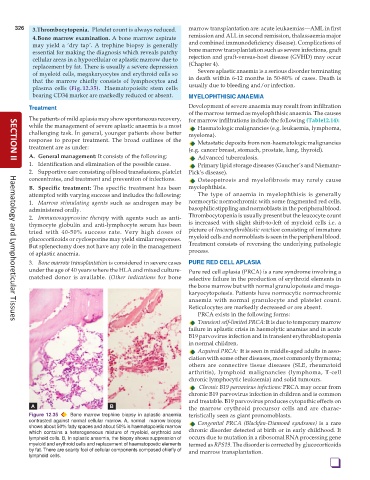
            4.Bone marrow examination. A bone marrow aspirate  remission and ALL in second remission, thalassaemia major
            may yield a ‘dry tap’. A trephine biopsy is generally  and combined immunodeficiency disease). Complications of
            essential for making the diagnosis which reveals patchy  bone marrow transplantation such as severe infections, graft
            cellular areas in a hypocellular or aplastic marrow due to  rejection and graft-versus-host disease (GVHD) may occur
            replacement by fat. There is usually a severe depression  (Chapter 4).
            of myeloid cells, megakaryocytes and erythroid cells so  Severe aplastic anaemia is a serious disorder terminating
            that the marrow chiefly consists of lymphocytes and  in death within 6-12 months in 50-80% of cases. Death is
            plasma cells  (Fig. 12.35).  Haematopoieitc stem cells  usually due to bleeding and/or infection.
            bearing CD34 marker are markedly reduced or absent.  MYELOPHTHISIC ANAEMIA

           Treatment                                           Development of severe anaemia may result from infiltration
                                                               of the marrow termed as myelophthisic anaemia. The causes
           The patients of mild aplasia may show spontaneous recovery,  for marrow infiltrations include the following (Table12.14):
           while the management of severe aplastic anaemia is a most  Haematologic malignancies (e.g. leukaemia, lymphoma,
           challenging task. In general, younger patients show better  myeloma).
           response to proper treatment. The broad outlines of the  Metastatic deposits from non-haematologic malignancies
           treatment are as under:                             (e.g. cancer breast, stomach, prostate, lung, thyroid).
           A. General management: It consists of the following:   Advanced tuberculosis.
     SECTION II
           1. Identification and elimination of the possible cause.  Primary lipid storage diseases (Gaucher’s and Niemann-
           2. Supportive care consisting of blood transfusions, platelet  Pick’s disease).
           concentrates, and treatment and prevention of infections.  Osteopetrosis and myelofibrosis may rarely cause
           B. Specific  treatment: The specific treatment has been  myelophthisis.
           attempted with varying success and includes the following:  The type of anaemia in myelophthisis is generally
           1. Marrow stimulating agents such as androgen may be  normocytic normochromic with some fragmented red cells,
           administered orally.                                basophilic stippling and normoblasts in the peripheral blood.
           2. Immunosuppressive therapy with agents such as anti-  Thrombocytopenia is usually present but the leucocyte count
           thymocyte globulin and anti-lymphocyte serum has been  is increased with slight shift-to-left of myeloid cells i.e. a
           tried with 40-50% success rate. Very high doses of  picture of leucoerythroblastic reaction consisting of immature
           glucocorticoids or cyclosporine may yield similar responses.  myeloid cells and normoblasts is seen in the peripheral blood.
           But splenectomy does not have any role in the management  Treatment consists of reversing the underlying pathologic
           of aplastic anaemia.                                process.
           3. Bone marrow transplantation is considered in severe cases  PURE RED CELL APLASIA
           under the age of 40 years where the HLA and mixed culture-  Pure red cell aplasia (PRCA) is a rare syndrome involving a
           matched donor is available. (Other indications for bone  selective failure in the production of erythroid elements in
                                                               the bone marrow but with normal granulopoiesis and mega-
                                                               karyocytopoiesis. Patients have normocytic normochromic
                                                               anaemia with normal granulocyte and platelet count.
                                                               Reticulocytes are markedly decreased or are absent.
                                                                  PRCA exists in the following forms:
                                                                  Transient self-limited PRCA: It is due to temporary marrow
     Haematology and Lymphoreticular Tissues
                                                               failure in aplastic crisis in haemolytic anamias and in acute
                                                               B19 parvovirus infection and in transient erythroblastopenia
                                                               in normal children.
                                                                  Acquired PRCA:  It is seen in middle-aged adults in asso-
                                                               ciation with some other diseases, most commonly thymoma;
                                                               others are connective tissue diseases (SLE, rheumatoid
                                                               arthritis), lymphoid malignancies (lymphoma, T-cell
                                                               chronic lymphocytic leukaemia) and solid tumours.
                                                                   Chronic B19 parvovirus infections: PRCA may occur from
                                                               chronic B19 parvovirus infection in children and is common
                                                               and treatable. B19 parvovirus produces cytopathic effects on
                                                               the marrow erythroid precursor cells and are charac-
           Figure 12.35  Bone marrow trephine biopsy in aplastic anaemia  teristically seen as giant pronomoblasts.
           contrasted against normal cellular marrow. A, normal  marrow biopsy  Congenital PRCA (Blackfan-Diamond syndrome) is a rare
           shows about 50% fatty spaces and about 50% is haematopoietic marrow  chronic disorder detected at birth or in early childhood. It
           which contains a heterogeneous mixture of myeloid, erythroid and
           lymphoid cells. B, In aplastic anaemia, the biopsy shows suppression of  occurs due to mutation in a ribosomal RNA processing gene
           myeloid and erythroid cells and replacement of haematopoetic elements  termed as RPS19. The disorder is corrected by glucocorticoids
           by fat. There are scanty foci of cellular components composed chiefly of  and marrow transplantation.
           lymphoid cells.
                                                                                                              ❑

