


Page 394 - Textbook of Pathology, 6th Edition
P. 394
378


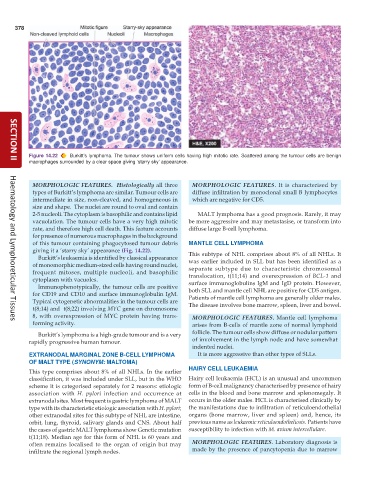
           Figure 14.22  Burkitt’s lymphoma. The tumour shows uniform cells having high mitotic rate. Scattered among the tumour cells are benign
           macrophages surrounded by a clear space giving ‘starry sky’ appearance.
     SECTION II

            MORPHOLOGIC FEATURES.  Histologically all three      MORPHOLOGIC FEATURES. It is characterised by
            types of Burkitt’s lymphoma are similar. Tumour cells are  diffuse infiltration by monoclonal small B lymphocytes
            intermediate in size, non-cleaved, and homogeneous in  which are negative for CD5.
            size and shape.  The nuclei are round to oval and contain
            2-5 nucleoli. The cytoplasm is basophilic and contains lipid  MALT lymphoma has a good prognosis. Rarely, it may
            vacuolation. The tumour cells have a very high mitotic  be more aggressive and may metastasise, or transform into
            rate, and therefore high cell death. This feature accounts  diffuse large B-cell lymphoma.
            for presence of numerous macrophages in the background
            of this tumour containing phagocytosed tumour debris  MANTLE CELL LYMPHOMA
            giving it a ‘starry sky’ appearance (Fig. 14.22).  This subtype of NHL comprises about 8% of all NHLs. It
              Burkitt’s leukaemia is identified by classical appearance
            of monomorphic medium-sized cells having round nuclei,  was earlier included in SLL but has been identified as a
                                                               separate subtype due to characteristic chromosomal
            frequent mitoses, multiple nucleoli, and basophilic  translocation, t(11;14) and overexpression of BCL-1  and
            cytoplasm with vacuoles.                           surface immunoglobulins IgM and IgD protein. However,
              Immunophenotypically, the tumour cells are positive
            for CD19 and CD10 and surface immunoglobulin IgM.  both SLL and mantle cell NHL are positive for CD5 antigen.
                                                               Patients of mantle cell lymphoma are generally older males.
            Typical cytogenetic abnormalities in the tumour cells are  The disease involves bone marrow, spleen, liver and bowel.
            t(8;14) and  t(8;22) involving MYC gene on chromosome
            8, with overexpression of MYC protein having trans-  MORPHOLOGIC FEATURES. Mantle cell lymphoma
            forming activity.                                    arises from B-cells of mantle zone of normal lymphoid
     Haematology and Lymphoreticular Tissues
              Burkitt’s lymphoma is a high-grade tumour and is a very  follicle. The tumour cells show diffuse or nodular pattern
           rapidly progressive human tumour.                     of involvement in the lymph node and have somewhat
                                                                 indented nuclei.
           EXTRANODAL MARGINAL ZONE B-CELL LYMPHOMA               It is more aggressive than other types of SLLs.
           OF MALT TYPE (SYNONYM: MALTOMA)
           This type comprises about 8% of all NHLs. In the earlier  HAIRY CELL LEUKAEMIA
           classification, it was included under SLL, but in the WHO  Hairy cell leukaemia (HCL) is an unusual and uncommon
           scheme it is categorised separately for 2 reasons: etiologic  form of B-cell malignancy characterised by presence of hairy
           association with  H. pylori infection and occurrence at  cells in the blood and bone marrow and splenomegaly. It
           extranodal sites. Most frequent is gastric lymphoma of MALT  occurs in the older males. HCL is characterised clinically by
           type with its characteristic etiologic association with H. pylori;  the manifestations due to infiltration of reticuloendothelial
           other extranodal sites for this subtype of NHL are intestine,  organs (bone marrow, liver and spleen) and, hence, its
           orbit, lung, thyroid, salivary glands and CNS. About half  previous name as leukaemic reticuloendotheliosis. Patients have
           the cases of gastric MALT lymphoma show Genetic mutation  susceptibility to infection with M. avium intercellulare.
           t(11;18). Median age for this form of NHL is 60 years and
           often remains localised to the organ of origin but may  MORPHOLOGIC FEATURES. Laboratory diagnosis is
           infiltrate the regional lymph nodes.                  made by the presence of pancytopenia due to marrow

