


Page 646 - Textbook of Pathology, 6th Edition
P. 646
630 generalised hepatic fibrosis without nodular regenerative 10. Musculoskeletal abnormalities like digital clubbing,
activity and there is absence of clinical and functional hypertrophic osteoarthropathy and Dupuytren’s contracture
evidence of cirrhosis. Besides, the patients of NCPF are are more common in cirrhotic patients.
relatively young as compared to those of cirrhosis and 11. Endocrine disorders. In males these consist of feminisation
develop repeated bouts of haematemesis in the course of such as gynaecomastia, changes in pubic hair pattern,
disease. One of the types associated with increased portal testicular atrophy and impotence, whereas in cirrhotic
fibrosis without definite cirrhosis is seen in idiopathic women amenorrhoea is a frequent abnormality.
(primary) portal hypertension with splenomegaly, reported from 12. Hepatorenal syndrome leading to renal failure may occur
India and Japan. The type common in India, particularly in in late stages of cirrhosis.
young males, is related to chronic arsenic ingestion in drinking The ultimate causes of death are hepatic coma, massive
water and intake of orthodox medicines. It could also be due gastrointestinal haemorrhage from oesophageal varices
to portal vein thrombosis leading to intimal sclerosis of portal (complication of portal hypertension), intercurrent infections,
vein branches. Another variant is congenital hepatic fibrosis hepatorenal syndrome and development of hepatocellular
seen in polycystic disease of the liver. carcinoma.
MORPHOLOGIC FEATURES. Grossly, the liver is small,
fibrous and shows prominent fibrous septa on both PORTAL HYPERTENSION
external as well as on cut surface forming irregular islands Increase in pressure in the portal system usually follows
in the liver. obstruction to the portal blood flow anywhere along its
Histologically, the salient features are as under: course. Portal veins have no valves and thus obstruction
i) Standing out of portal tracts due to their increased anywhere in the portal system raises pressure in all the veins
amount of fibrous tissue in triad without significant proximal to the obstruction. However, unless proved
inflammation. otherwise, portal hypertension means obstruction to the
ii) Obliterative sclerosis of portal vein branches in the portal blood flow by cirrhosis of the liver. The normal portal
portal tracts (obliterative portovenopathy). venous pressure is quite low (10-15 mm saline). Portal
hypertension occurs when the portal pressure is above 30
CLINICAL MANIFESTATIONS AND mm saline. Measurement of intrasplenic pressure reflects
COMPLICATIONS OF CIRRHOSIS pressure in the splenic vein; the percutaneous transhepatic
pressure provides a measure of pressure in the main portal
The range of clinical features in cirrhosis varies widely, from vein; and wedged hepatic venous pressure represents
SECTION III
an asymptomatic state to progressive liver failure and death. sinusoidal pressure. Measurement of these pressures helps
The onset of disease is insidious. In general, the features of in localising the site of obstruction and classifying the portal
cirrhosis are more marked in the alcoholic form than in other hypertension.
varieties. These include weakness, fatiguability, weight loss,
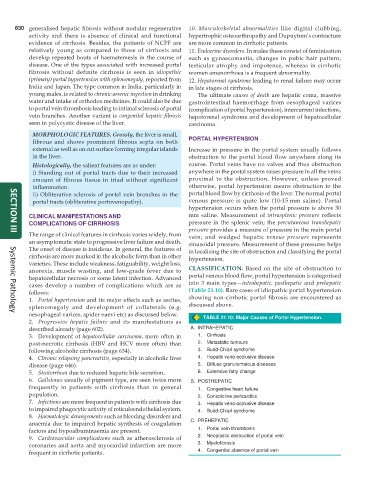
anorexia, muscle wasting, and low-grade fever due to CLASSIFICATION. Based on the site of obstruction to
hepatocellular necrosis or some latent infection. Advanced portal venous blood flow, portal hypertension is categorised
cases develop a number of complications which are as into 3 main types—intrahepatic, posthepatic and prehepatic
follows: (Table 21.10). Rare cases of idiopathic portal hypertension
1. Portal hypertension and its major effects such as ascites, showing non-cirrhotic portal fibrosis are encountered as
splenomegaly and development of collaterals (e.g. discussed above.
oesophageal varices, spider naevi etc) as discussed below. TABLE 21.10: Major Causes of Portal Hypertension.
Systemic Pathology
2. Progressive hepatic failure and its manifestations as
described already (page 602). A. INTRAHEPATIC
3. Development of hepatocellular carcinoma, more often in 1. Cirrhosis
post-necrotic cirrhosis (HBV and HCV more often) than 2. Metastatic tumours
following alcoholic cirrhosis (page 634). 3. Budd-Chiari syndrome
4. Chronic relapsing pancreatitis, especially in alcoholic liver 4. Hepatic veno-occlusive disease
disease (page 646). 5. Diffuse granulomatous diseases
5. Steatorrhoea due to reduced hepatic bile secretion. 6. Extensive fatty change
6. Gallstones usually of pigment type, are seen twice more B. POSTHEPATIC
frequently in patients with cirrhosis than in general 1. Congestive heart failure
population. 2. Constrictive pericarditis
7. Infections are more frequent in patients with cirrhosis due 3. Hepatic veno-occlusive disease
to impaired phagocytic activity of reticuloendothelial system. 4. Budd-Chiari syndrome
8. Haematologic derangements such as bleeding disorders and
anaemia due to impaired hepatic synthesis of coagulation C. PREHEPATIC
factors and hypoalbuminaemia are present. 1. Portal vein thrombosis
9. Cardiovascular complications such as atherosclerosis of 2. Neoplastic obstruction of portal vein
coronaries and aorta and myocardial infarction are more 3. Myelofibrosis
frequent in cirrhotic patients. 4. Congenital absence of portal vein

