


Page 647 - Textbook of Pathology, 6th Edition
P. 647
1. Intrahepatic portal hypertension. Cirrhosis is by far the                                             631
           commonest cause of portal hypertension. Other less frequent
           intrahepatic causes are metastatic tumours, non-cirrhotic
           nodular regenerative conditions, hepatic venous obstruction
           (Budd-Chiari syndrome), veno-occlusive disease,
           schistosomiasis, diffuse granulomatous diseases and
           extensive fatty change. In cirrhosis and other conditions,
           there is obstruction to the portal venous flow by fibrosis,
           thrombosis and pressure by regenerative nodules. About 30-
           60% patients of cirrhosis develop significant portal
           hypertension.
           2. Posthepatic portal hypertension. This is uncommon and
           results from obstruction to the blood flow through hepatic
           vein into inferior vena cava. The causes are neoplastic
           occlusion and thrombosis of the hepatic vein or of the inferior
           vena cava (including Budd-Chiari syndrome). Prolonged
           congestive heart failure and constrictive pericarditis may also
           cause portal hypertension by transmitting the elevated
           pressure through the hepatic vessels into the portal vein.
           3. Prehepatic portal hypertension. Blockage of portal flow
           before portal blood reaches the hepatic sinusoids results in
           prehepatic portal hypertension. Such conditions are
           thrombosis and neoplastic obstruction of the portal vein
           before it ramifies in the liver, myelofibrosis, and congenital
           absence of portal vein.

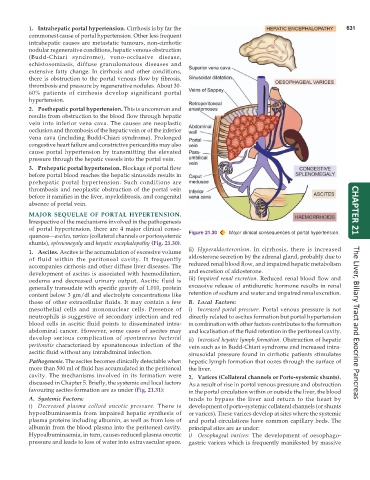
           MAJOR SEQUELAE OF PORTAL HYPERTENSION.                                                                     CHAPTER 21
           Irrespective of the mechanisms involved in the pathogenesis
           of portal hypertension, there are 4 major clinical conse-
           quences—ascites, varices (collateral channels or portosystemic  Figure 21.30  Major clinical consequences of portal hypertension.
           shunts), splenomegaly and hepatic encephalopathy (Fig. 21.30).
                                                               ii) Hyperaldosteronism. In cirrhosis, there is increased
           1. Ascites. Ascites is the accumulation of excessive volume
           of fluid within the peritoneal cavity. It frequently  aldosterone secretion by the adrenal gland, probably due to
           accompanies cirrhosis and other diffuse liver diseases. The  reduced renal blood flow, and impaired hepatic metabolism
           development of ascites is associated with haemodilution,  and excretion of aldosterone.
           oedema and decreased urinary output. Ascitic fluid is  iii) Impaired renal excretion. Reduced renal blood flow and
           generally transudate with specific gravity of 1.010, protein  excessive release of antidiuretic hormone results in renal
           content below 3 gm/dl and electrolyte concentrations like  retention of sodium and water and impaired renal excretion.
           those of other extracellular fluids. It may contain a few  B. Local  Factors:
           mesothelial cells and mononuclear cells. Presence of  i) Increased portal pressure. Portal venous pressure is not
           neutrophils is suggestive of secondary infection and red  directly related to ascites formation but portal hypertension
           blood cells in ascitic fluid points to disseminated intra-  in combination with other factors contributes to the formation  The Liver, Biliary Tract and Exocrine Pancreas
           abdominal cancer. However, some cases of ascites may  and localisation of the fluid retention in the peritoneal cavity.
           develop serious complication of  spontaneous bacterial  ii) Increased hepatic lymph formation. Obstruction of hepatic
           peritonitis characterised by sponateneous infection of the  vein such as in Budd-Chiari syndrome and increased intra-
           ascitic fluid without any intrabdminal infection.   sinusoidal pressure found in cirrhotic patients stimulates
           Pathogenesis. The ascites becomes clinically detectable when  hepatic lymph formation that oozes through the surface of
           more than 500 ml of fluid has accumulated in the peritoneal  the liver.
           cavity. The mechanisms involved in its formation were  2. Varices (Collateral channels or Porto-systemic shunts).
           discussed in Chapter 5. Briefly, the systemic and local factors  As a result of rise in portal venous pressure and obstruction
           favouring ascites formation are as under (Fig. 21.31):  in the portal circulation within or outside the liver, the blood
           A. Systemic Factors:                                tends to bypass the liver and return to the heart by
           i) Decreased plasma colloid oncotic pressure. There is  development of porto-systemic collateral channels (or shunts
           hypoalbuminaemia from impaired hepatic synthesis of  or varices). These varices develop at sites where the systemic
           plasma proteins including albumin, as well as from loss of  and portal circulations have common capillary beds. The
           albumin from the blood plasma into the peritoneal cavity.  principal sites are as under:
           Hypoalbuminaemia, in turn, causes reduced plasma oncotic  i) Oesophageal varices: The development of oesophago-
           pressure and leads to loss of water into extravascular space.  gastric varices which is frequently manifested by massive

