


Page 651 - Textbook of Pathology, 6th Edition
P. 651
635


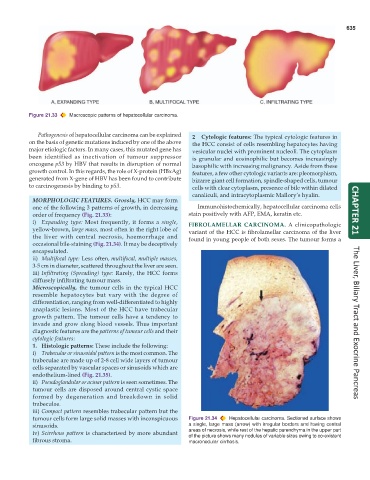
           Figure 21.33  Macroscopic patterns of hepatocellular carcinoma.


              Pathogenesis of hepatocellular carcinoma can be explained  2  Cytologic features: The typical cytologic features in
           on the basis of genetic mutations induced by one of the above  the HCC consist of cells resembling hepatocytes having
           major etiologic factors. In many cases, this mutated gene has  vesicular nuclei with prominent nucleoli. The cytoplasm
           been identified as inactivation of tumour suppressor  is granular and eosinophilic but becomes increasingly
           oncogene p53 by HBV that results in disruption of normal  basophilic with increasing malignancy. Aside from these
           growth control. In this regards, the role of X-protein (HBxAg)  features, a few other cytologic variants are: pleomorphism,
           generated from X-gene of HBV has been found to contribute  bizarre giant cell formation, spindle-shaped cells, tumour
           to carcinogenesis by binding to p53.                  cells with clear cytoplasm, presence of bile within dilated
                                                                 canaliculi, and intracytoplasmic Mallory’s hyalin.
            MORPHOLOGIC FEATURES. Grossly, HCC may form
            one of the following 3 patterns of growth, in decreasing  Immunohistochemically, hepatocellular carcinoma cells
            order of frequency (Fig. 21.33):                   stain positively with AFP, EMA, keratin etc.           CHAPTER 21
            i) Expanding type: Most frequently, it forms a  single,  FIBROLAMELLAR CARCINOMA.  A clinicopathologic
            yellow-brown, large mass, most often in the right lobe of  variant of the HCC is fibrolamellar carcinoma of the liver
            the liver with central necrosis, haemorrhage and   found in young people of both sexes. The tumour forms a
            occasional bile-staining (Fig. 21.34). It may be deceptively
            encapsulated.
            ii) Multifocal type: Less often, multifocal, multiple masses,
            3-5 cm in diameter, scattered throughout the liver are seen.
            iii) Infiltrating (Spreading) type: Rarely, the HCC forms
            diffusely infiltrating tumour mass.
            Microscopically, the tumour cells in the typical HCC
            resemble hepatocytes but vary with the degree of
            differentiation, ranging from well-differentiated to highly
            anaplastic lesions. Most of the HCC have trabecular
            growth pattern. The tumour cells have a tendency to
            invade and grow along blood vessels. Thus important                                                       The Liver, Biliary Tract and Exocrine Pancreas
            diagnostic features are the patterns of tumour cells and their
            cytologic features:
            1. Histologic patterns: These include the following:
            i) Trabecular or sinusoidal pattern is the most common. The
            trabeculae are made up of 2-8 cell wide layers of tumour
            cells separated by vascular spaces or sinusoids which are
            endothelium-lined (Fig. 21.35).
            ii) Pseudoglandular or acinar pattern is seen sometimes. The
            tumour cells are disposed around central cystic space
            formed by degeneration and breakdown in solid
            trabeculae.
            iii) Compact pattern resembles trabecular pattern but the
            tumour cells form large solid masses with inconspicuous  Figure 21.34  Hepatocellular carcinoma. Sectioned surface shows
            sinusoids.                                         a single, large mass (arrow) with irregular borders and having central
            iv) Scirrhous pattern is characterised by more abundant  areas of necrosis, while rest of the hepatic parenchyma in the upper part
                                                               of the picture shows many nodules of variable sizes owing to co-existent
            fibrous stroma.                                    macronodular cirrhosis.

