


Page 642 - Textbook of Pathology, 6th Edition
P. 642
626 B. Secondary biliary cirrhosis. Most cases of secondary
           biliary cirrhosis result from prolonged obstruction of
           extrahepatic biliary passages (page 599). These causes
           include the following:
           1. Extrahepatic cholelithiasis, most common
           2. Biliary atresia
           3. Cancer of biliary tree and of head of pancreas
           4. Postoperative strictures with superimposed ascending
           cholangitis.
           C. Cirrhosis due to primary sclerosing cholangitis. Primary
           or idiopathic sclerosing cholangitis is a chronic cholestatic
           syndrome of unknown etiology. It is characterised by
           progressive, inflammatory, sclerosing and obliterative
           process affecting the entire biliary passages, both extra-
           hepatic and intrahepatic ducts. Although etiology remains
           unknown, various mechanisms have been postulated which
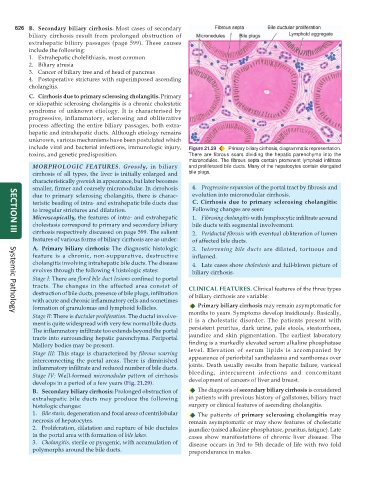
           include viral and bacterial infections, immunologic injury,  Figure 21.29  Primary biliary cirrhosis, diagrammatic representation.
           toxins, and genetic predisposition.                 There are fibrous scars dividing the hepatic parenchyma into the
                                                               micronodules. The fibrous septa contain prominent lymphoid infiltrate
            MORPHOLOGIC FEATURES. Grossly, in biliary          and proliferated bile ducts. Many of the hepatocytes contain elongated
            cirrhosis of all types, the liver is initially enlarged and  bile plugs.
            characteristically greenish in appearance, but later becomes
            smaller, firmer and coarsely micronodular. In cirrohosis  4. Progressive expansion of the portal tract by fibrosis and
            due to primary sclerosing cholangitis, there is charac-  evolution into micronodular cirrhosis.
            teristic beading of intra- and extrahepatic bile ducts due  C. Cirrhosis due to primary sclerosing cholangitis:
            to irregular strictures and dilatation.              Following changes are seen:
            Microscopically, the features of intra- and extrahepatic  1. Fibrosing cholangitis with lymphocytic infiltrate around
            cholestasis correspond to primary and secondary biliary  bile ducts with segmental involvement.
            cirrhosis respectively discussed on page 599. The salient  2. Periductal fibrosis with eventual obliteration of lumen
     SECTION III
            features of various forms of biliary cirrhosis are as under:  of affected bile ducts.
            A. Primary biliary cirrhosis: The diagnostic histologic  3. Intervening bile ducts are dilated, tortuous and
            feature is a chronic, non-suppurative, destructive   inflamed.
            cholangitis involving intrahepatic bile ducts. The disease  4. Late cases show cholestasis and full-blown picture of
            evolves through the following 4 histologic states:   biliary cirrhosis.
            Stage I: There are florid bile duct lesions confined to portal
            tracts. The changes in the affected area consist of  CLINICAL FEATURES. Clinical features of the three types
            destruction of bile ducts, presence of bile plugs, infiltration  of biliary cirrhosis are variable:
            with acute and chronic inflammatory cells and sometimes
            formation of granulomas and lymphoid follicles.       Primary biliary cirrhosis may remain asymptomatic for
     Systemic Pathology
            Stage II: There is ductular proliferation. The ductal involve-  months to years. Symptoms develop insidiously. Basically,
            ment is quite widespread with very few normal bile ducts.  it is a cholestatic disorder. The patients present with
            The inflammatory infiltrate too extends beyond the portal  persistent pruritus, dark urine, pale stools, steatorrhoea,
            tracts into surrounding hepatic parenchyma. Periportal  jaundice and skin pigmentation. The earliest laboratory
            Mallory bodies may be present.                     finding is a markedly elevated serum alkaline phosphatase
                                                               level. Elevation of serum lipids is accompanied by
            Stage III: This stage is characterised by fibrous scarring  appearance of periorbital xanthelasma and xanthomas over
            interconnecting the portal areas. There is diminished
            inflammatory infiltrate and reduced number of bile ducts.  joints. Death usually results from hepatic failure, variceal
            Stage IV: Well-formed  micronodular pattern of cirrhosis  bleeding, intercurrent infections and concomitant
            develops in a period of a few years (Fig. 21.29).  development of cancers of liver and breast.
            B. Secondary biliary cirrhosis: Prolonged obstruction of  The diagnosis of secondary biliary cirrhosis is considered
            extrahepatic bile ducts may produce the following  in patients with previous history of gallstones, biliary tract
            histologic changes:                                surgery or clinical features of ascending cholangitis.
            1. Bile stasis, degeneration and focal areas of centrilobular  The patients of primary sclerosing cholangitis may
            necrosis of hepatocytes.                           remain asymptomatic or may show features of cholestatic
            2. Proliferation, dilatation and rupture of bile ductules  jaundice (raised alkaline phosphatase, pruritus, fatigue). Late
            in the portal area with formation of bile lakes.   cases show manifestations of chronic liver disease. The
            3. Cholangitis, sterile or pyogenic, with accumulation of  disease occurs in 3rd to 5th decade of life with two fold
            polymorphs around the bile ducts.                  preponderance in males.

