


Page 652 - Textbook of Pathology, 6th Edition
P. 652
636


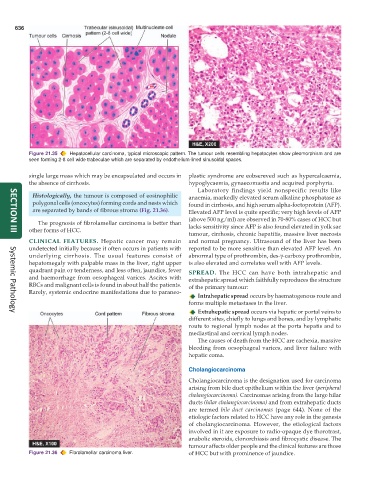
           Figure 21.35  Hepatocellular carcinoma, typical microscopic pattern. The tumour cells resembling hepatocytes show pleomorphism and are
           seen forming 2-8 cell wide trabeculae which are separated by endothelium-lined sinusoidal spaces.


           single large mass which may be encapsulated and occurs in  plastic syndrome are eobsereved such as hypercalcaemia,
           the absence of cirrhosis.                           hypoglycaemia, gynaecomastia and acquired porphyria.
                                                                  Laboratory findings yield nonspecific results like
            Histologically, the tumour is composed of eosinophilic  anaemia, markedly elevated serum alkaline phosphatase as
            polygonal cells (oncocytes) forming cords and nests which  found in cirrhosis, and high serum alpha-foetoprotein (AFP).
            are separated by bands of fibrous stroma (Fig. 21.36).  Elevated AFP level is quite specific; very high levels of AFP
                                                               (above 500 ng/ml) are observed in 70-80% cases of HCC but
              The prognosis of fibrolamellar carcinoma is better than
           other forms of HCC.                                 lacks sensitivity since AFP is also found elevated in yolk sac
                                                               tumour, cirrhosis, chronic hepatitis, massive liver necrosis
     SECTION III
           CLINICAL FEATURES.  Hepatic cancer may remain       and normal pregnancy. Ultrasound of the liver has been
           undetected initially because it often occurs in patients with  reported to be more sensitive than elevated AFP level. An
           underlying cirrhosis. The usual features consist of  abnormal type of prothrombin, des-γ-carboxy prothrombin,
           hepatomegaly with palpable mass in the liver, right upper  is also elevated and correlates well with AFP levels.
           quadrant pain or tenderness, and less often, jaundice, fever  SPREAD.  The HCC can have both intrahepatic and
           and haemorrhage from oesophageal varices. Ascites with  extrahepatic spread which faithfully reproduces the structure
           RBCs and malignant cells is found in about half the patients.  of the primary tumour:
           Rarely, systemic endocrine manifestations due to paraneo-
                                                                  Intrahepatic spread occurs by haematogenous route and
                                                               forms multiple metastases in the liver.
                                                                  Extrahepatic spread occurs via hepatic or portal veins to
     Systemic Pathology
                                                               different sites, chiefly to lungs and bones, and by lymphatic
                                                               route to regional lymph nodes at the porta hepatis and to
                                                               mediastinal and cervical lymph nodes.
                                                                  The causes of death from the HCC are cachexia, massive
                                                               bleeding from oesophageal varices, and liver failure with
                                                               hepatic coma.


                                                               Cholangiocarcinoma
                                                               Cholangiocarcinoma is the designation used for carcinoma
                                                               arising from bile duct epithelium within the liver (peripheral
                                                               cholangiocarcinoma). Carcinomas arising from the large hilar
                                                               ducts (hilar cholangiocarcinoma) and from extrahepatic ducts
                                                               are termed  bile duct carcinomas (page 644). None of the
                                                               etiologic factors related to HCC have any role in the genesis
                                                               of cholangiocarcinoma. However, the etiological factors
                                                               involved in it are exposure to radio-opaque dye thorotrast,
                                                               anabolic steroids, clonorchiasis and fibrocystic disease. The
                                                               tumour affects older people and the clinical features are those
           Figure 21.36  Fibrolamellar carcinoma liver.        of HCC but with prominence of jaundice.

