


Page 657 - Textbook of Pathology, 6th Edition
P. 657
641


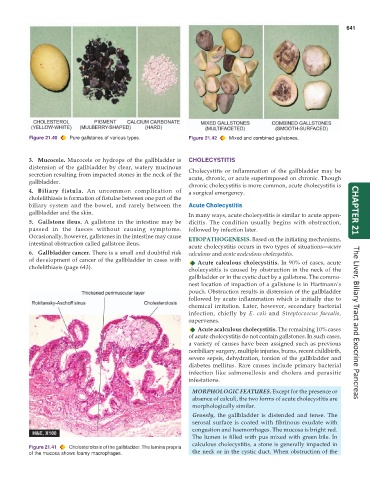
           Figure 21.40  Pure gallstones of various types.     Figure 21.42  Mixed and combined gallstones.


           3. Mucocele. Mucocele or hydrops of the gallbladder is  CHOLECYSTITIS
           distension of the gallbladder by clear, watery mucinous  Cholecystitis or inflammation of the gallbladder may be
           secretion resulting from impacted stones in the neck of the  acute, chronic, or acute superimposed on chronic. Though
           gallbladder.
                                                               chronic cholecystitis is more common, acute cholecystitis is
           4. Biliary fistula. An uncommon complication of     a surgical emergency.
           cholelithiasis is formation of fistulae between one part of the
           biliary system and the bowel, and rarely between the  Acute Cholecystitis
           gallbladder and the skin.                           In many ways, acute cholecystitis is similar to acute appen-  CHAPTER 21
           5. Gallstone ileus. A gallstone in the intestine may be  dicitis. The condition usually begins with obstruction,
           passed in the faeces without causing symptoms.      followed by infection later.
           Occasionally, however, gallstones in the intestine may cause  ETIOPATHOGENESIS. Based on the initiating mechanisms,
           intestinal obstruction called gallstone ileus.
                                                               acute cholecystitis occurs in two types of situations—acute
           6. Gallbladder cancer. There is a small and doubtful risk  calculous and acute acalculous cholecystitis.
           of development of cancer of the gallbladder in cases with  Acute calculous cholecystitis. In 90% of cases, acute
           cholelithiasis (page 643).                          cholecystitis is caused by obstruction in the neck of the
                                                               gallbladder or in the cystic duct by a gallstone. The commo-
                                                               nest location of impaction of a gallstone is in Hartmann’s
                                                               pouch. Obstruction results in distension of the gallbladder
                                                               followed by acute inflammation which is initially due to
                                                               chemical irritation. Later, however, secondary bacterial
                                                               infection, chiefly by  E. coli and  Streptococcus faecalis,
                                                               supervenes.                                            The Liver, Biliary Tract and Exocrine Pancreas
                                                                  Acute acalculous cholecystitis. The remaining 10% cases
                                                               of acute cholecystitis do not contain gallstones. In such cases,
                                                               a variety of causes have been assigned such as previous
                                                               nonbiliary surgery, multiple injuries, burns, recent childbirth,
                                                               severe sepsis, dehydration, torsion of the gallbladder and
                                                               diabetes mellitus. Rare causes include primary bacterial
                                                               infection like salmonellosis and cholera and parasitic
                                                               infestations.
                                                                 MORPHOLOGIC FEATURES. Except for the presence or
                                                                 absence of calculi, the two forms of acute cholecystitis are
                                                                 morphologically similar.
                                                                 Grossly, the gallbladder is distended and tense. The
                                                                 serosal surface is coated with fibrinous exudate with
                                                                 congestion and haemorrhages. The mucosa is bright red.
                                                                 The lumen is filled with pus mixed with green bile. In
                                                                 calculous cholecystitis, a stone is generally impacted in
           Figure 21.41  Cholesterolosis of the gallbladder. The lamina propria
           of the mucosa shows foamy macrophages.                the neck or in the cystic duct. When obstruction of the

