


Page 656 - Textbook of Pathology, 6th Edition
P. 656
640
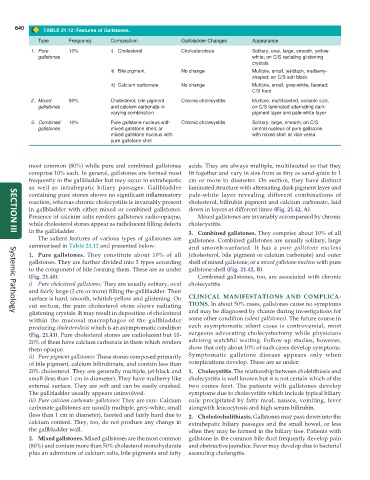
TABLE 21.12: Features of Gallstones.
Type Frequency Composition Gallbladder Changes Appearance
1. Pure 10% i) Cholesterol Cholesterolosis Solitary, oval, large, smooth, yellow-
gallstones white; on C/S radiating glistening
crystals
ii) Bile pigment No change Multiple, small, jet-black, mulberry-
shaped; on C/S soft black
iii) Calcium carbonate No change Multiple, small, grey-white, faceted;
C/S hard
2. Mixed 80% Cholesterol, bile pigment Chronic cholecystitis Multiple, multifaceted, variable size,
gallstones and calcium carbonate in on C/S laminated alternating dark-
varying combination pigment layer and pale-white layer
3. Combined 10% Pure gallstone nucleus with Chronic cholecystitis Solitary, large, smooth; on C/S
gallstones mixed gallstone shell, or central nucleus of pure gallstone
mixed gallstone nucleus with with mixed shell or vice versa
pure gallstone shell
most common (80%) while pure and combined gallstones acids. They are always multiple, multifaceted so that they
comprise 10% each. In general, gallstones are formed most fit together and vary in size from as tiny as sand-grain to 1
frequently in the gallbladder but may occur in extrahepatic cm or more in diameter. On section, they have distinct
as well as intrahepatic biliary passages. Gallbladder laminated structure with alternating dark pigment layer and
containing pure stones shows no significant inflammatory pale-white layer revealing different combinations of
reaction, whereas chronic cholecystitis is invariably present cholesterol, bilirubin pigment and calcium carbonate, laid
in gallbladder with either mixed or combined gallstones. down in layers at different times (Fig. 21.42, A).
Presence of calcium salts renders gallstones radio-opaque, Mixed gallstones are invariably accompanied by chronic
while cholesterol stones appear as radiolucent filling defects cholecystitis.
in the gallbladder. 3. Combined gallstones. They comprise about 10% of all
SECTION III
The salient features of various types of gallstones are gallstones. Combined gallstones are usually solitary, large
summarised in Table 21.12 and presented below:
and smooth-surfaced. It has a pure gallstone nucleus
1. Pure gallstones. They constitute about 10% of all (cholesterol, bile pigment or calcium carbonate) and outer
gallstones. They are further divided into 3 types according shell of mixed gallstone; or a mixed gallstone nucleus with pure
to the component of bile forming them. These are as under gallstone shell (Fig. 21.42, B).
(Fig. 21.40): Combined gallstones, too, are associated with chronic
i) Pure cholesterol gallstones: They are usually solitary, oval cholecystitis.
and fairly large (3 cm or more) filling the gallbladder. Their
surface is hard, smooth, whitish-yellow and glistening. On CLINICAL MANIFESTATIONS AND COMPLICA-
cut section, the pure cholesterol stone shows radiating TIONS. In about 50% cases, gallstones cause no symptoms
glistening crystals. It may result in deposition of cholesterol and may be diagnosed by chance during investigations for
Systemic Pathology
within the mucosal macrophages of the gallbladder some other condition (silent gallstones). The future course in
producing cholesterolosis which is an asymptomatic condition such asymptomatic silent cases is controversial, most
(Fig. 21.41). Pure cholesterol stones are radiolucent but 10- surgeons advocating cholecystectomy while physicians
20% of them have calcium carbonate in them which renders advising watchful waiting. Follow-up studies, however,
them opaque. show that only about 10% of such cases develop symptoms.
ii) Pure pigment gallstones: These stones composed primarily Symptomatic gallstone disease appears only when
of bile pigment, calcium bilirubinate, and contain less than complications develop. These are as under:
20% cholesterol. They are generally multiple, jet-black and 1. Cholecystitis. The relationship between cholelithiasis and
small (less than 1 cm in diameter). They have mulberry like cholecystitis is well known but it is not certain which of the
external surface. They are soft and can be easily crushed. two comes first. The patients with gallstones develop
The gallbladder usually appears uninvolved. symptoms due to cholecystitis which include typical biliary
iii) Pure calcium carbonate gallstones: They are rare. Calcium colic precipitated by fatty meal, nausea, vomiting, fever
carbonate gallstones are usually multiple, grey-white, small alongwith leucocytosis and high serum bilirubin.
(less than 1 cm in diameter), faceted and fairly hard due to 2. Choledocholithiasis. Gallstones may pass down into the
calcium content. They, too, do not produce any change in extrahepatic biliary passages and the small bowel, or less
the gallbladder wall. often they may be formed in the biliary tree. Patients with
2. Mixed gallstones. Mixed gallstones are the most common gallstone in the common bile duct frequently develop pain
(80%) and contain more than 50% cholesterol monohydarate and obstructive jaundice. Fever may develop due to bacterial
plus an admixture of calcium salts, bile pigments and fatty ascending cholangitis.

