


Page 653 - Textbook of Pathology, 6th Edition
P. 653
637


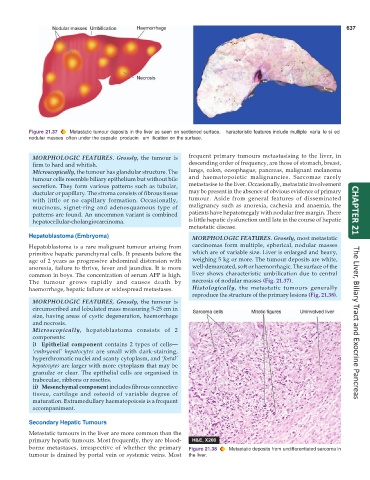
           Figure 21.37  Metastatic tumour deposits in the liver as seen on sectioned surface. Characteristic features include multiple, variable-sized,
           nodular masses, often under the capsule, producing umbilication on the surface.


            MORPHOLOGIC FEATURES. Grossly, the tumour is       frequent primary tumours metastasising to the liver, in
            firm to hard and whitish.                          descending order of frequency, are those of stomach, breast,
            Microscopically, the tumour has glandular structure. The  lungs, colon, oesophagus, pancreas, malignant melanoma
            tumour cells resemble biliary epithelium but without bile  and haematopoietic malignancies. Sarcomas rarely
            secretion. They form various patterns such as tubular,  metastasise to the liver. Occasionally, metastatic involvement
            ductular or papillary. The stroma consists of fibrous tissue  may be present in the absence of obvious evidence of primary
            with little or no capillary formation. Occasionally,  tumour. Aside from general features of disseminated
            mucinous, signet-ring and adenosquamous type of    malignancy such as anorexia, cachexia and anaemia, the
            patterns are found. An uncommon variant is combined  patients have hepatomegaly with nodular free margin. There  CHAPTER 21
            hepatocellular-cholangiocarcinoma.                 is little hepatic dysfunction until late in the course of hepatic
                                                               metastatic disease.
           Hepatoblastoma (Embryoma)                             MORPHOLOGIC FEATURES. Grossly, most metastatic
           Hepatoblastoma is a rare malignant tumour arising from  carcinomas form multiple, spherical, nodular masses
           primitive hepatic parenchymal cells. It presents before the  which are of variable size. Liver is enlarged and heavy,
           age of 2 years as progressive abdominal distension with  weighing 5 kg or more. The tumour deposits are white,
           anorexia, failure to thrive, fever and jaundice. It is more  well-demarcated, soft or haemorrhagic. The surface of the
           common in boys. The concentration of serum AFP is high.  liver shows characteristic umbilication due to central
           The tumour grows rapidly and causes death by          necrosis of nodular masses (Fig. 21.37).
           haemorrhage, hepatic failure or widespread metastases.  Histologically, the metastatic tumours generally
                                                                 reproduce the structure of the primary lesions (Fig. 21.38).
            MORPHOLOGIC FEATURES, Grossly, the tumour is
            circumscribed and lobulated mass measuring 5-25 cm in
            size, having areas of cystic degeneration, haemorrhage
            and necrosis.                                                                                             The Liver, Biliary Tract and Exocrine Pancreas
            Microscopically, hepatoblastoma consists of 2
            components:
            i) Epithelial component contains 2 types of cells—
            ‘embryonal’ hepatocytes are small with dark-staining,
            hyperchromatic nuclei and scanty cytoplasm, and ‘foetal’
            hepatocytes are larger with more cytoplasm that may be
            granular or clear. The epithelial cells are organised in
            trabeculae, ribbons or rosettes.
            ii) Mesenchymal component includes fibrous connective
            tissue, cartilage and osteoid of variable degree of
            maturation. Extramedullary haematopoiesis is a frequent
            accompaniment.
           Secondary Hepatic Tumours

           Metastatic tumours in the liver are more common than the
           primary hepatic tumours. Most frequently, they are blood-
           borne metastases, irrespective of whether the primary  Figure 21.38  Metastatic deposits from undifferentiated sarcoma in
           tumour is drained by portal vein or systemic veins. Most  the liver.

