


Page 658 - Textbook of Pathology, 6th Edition
P. 658
642


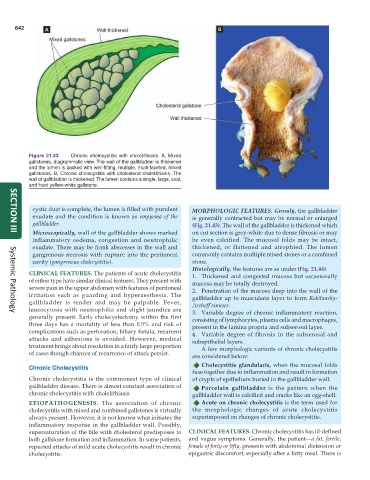
           Figure 21.43  Chronic cholecystitis with cholelithiasis. A, Mixed
           gallstones, diagrammatic view. The wall of the gallbladder is thickened
           and the lumen is packed with well-fitting, multiple, multi-faceted, mixed
           gallstones. B, Chronic cholecystitis with cholesterol cholelithiasis. The
           wall of gallbladder is thickened. The lumen contains a single, large, oval,
           and hard yellow-white gallstone.


            cystic duct is complete, the lumen is filled with purulent  MORPHOLOGIC FEATURES. Grossly, the gallbladder
            exudate and the condition is known as  empyema of the  is generally contracted but may be normal or enlarged
            gallbladder.                                         (Fig. 21.43). The wall of the gallbladder is thickened which
            Microscopically, wall of the gallbladder shows marked  on cut section is grey-white due to dense fibrosis or may
     SECTION III
            inflammatory oedema, congestion and neutrophilic     be even calcified. The mucosal folds may be intact,
            exudate. There may be frank abscesses in the wall and  thickened, or flattened and atrophied. The lumen
            gangrenous necrosis with rupture into the peritoneal  commonly contains multiple mixed stones or a combined
            cavity (gangrenous cholecystitis).                   stone.
                                                                 Histologically, the features are as under (Fig. 21.44):
           CLINICAL FEATURES. The patients of acute cholecystitis  1. Thickened and congested mucosa but occasionally
           of either type have similar clinical features. They present with  mucosa may be totally destroyed.
           severe pain in the upper abdomen with features of peritoneal  2. Penetration of the mucosa deep into the wall of the
           irritation such as guarding and hyperaesthesia. The
           gallbladder is tender and may be palpable. Fever,     gallbladder up to muscularis layer to form Rokitansky-
           leucocytosis with neutrophilia and slight jaundice are  Aschoff’sinuses.
                                                                 3. Variable degree of chronic inflammatory reaction,
     Systemic Pathology
           generally present. Early cholecystectomy within the first  consisting of lymphocytes, plasma cells and macrophages,
           three days has a mortality of less than 0.5% and risk of  present in the lamina propria and subserosal layer.
           complications such as perforation, biliary fistula, recurrent  4. Variable degree of fibrosis in the subserosal and
           attacks and adhesions is avoided. However, medical    subepithelial layers.
           treatment brings about resolution in a fairly large proportion  A few morphologic variants of chronic cholecystitis
           of cases though chances of recurrence of attack persist.
                                                                 are considered below:
                                                                    Cholecystitis glandularis, when the mucosal folds
           Chronic Cholecystitis
                                                                 fuse together due to inflammation and result in formation
           Chronic cholecystitis is the commonest type of clinical  of crypts of epithelium buried in the gallbladder wall.
           gallbladder disease. There is almost constant association of  Porcelain gallbladder is the pattern when the
           chronic cholecystitis with cholelithiasis.            gallbladder wall is calcified and cracks like an egg-shell.
           ETIOPATHOGENESIS.  The association of chronic            Acute on chronic cholecystitis is the term used for
           cholecystitis with mixed and combined gallstones is virtually  the morphologic changes of acute cholecystitis
           always present. However, it is not known what initiates the  superimposed on changes of chronic cholecystitis.
           inflammatory response in the gallbladder wall. Possibly,
           supersaturation of the bile with cholesterol predisposes to  CLINICAL FEATURES. Chronic cholecystitis has ill-defined
           both gallstone formation and inflammation. In some patients,  and vague symptoms. Generally, the patient—a fat, fertile,
           repeated attacks of mild acute cholecystitis result in chronic  female of forty or fifty, presents with abdominal distension or
           cholecystitis.                                      epigastric discomfort, especially after a fatty meal. There is

