


Page 659 - Textbook of Pathology, 6th Edition
P. 659
643


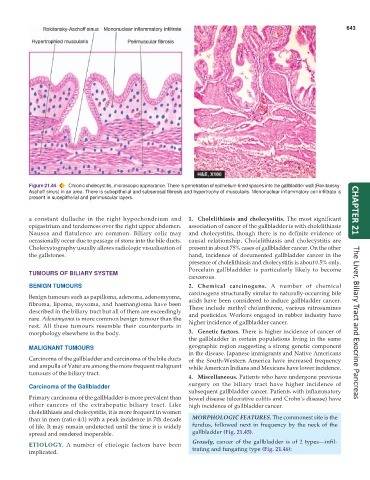
           Figure 21.44  Chronic cholecystitis, microscopic appearance. There is penetration of epithelium-lined spaces into the gallbladder wall (Rokitansky-
           Aschoff sinus) in an area. There is subepithelial and subserosal fibrosis and hypertrophy of muscularis. Mononuclear inflammatory cell infiltrate is
           present in subepithelial and perimuscular layers.


           a constant dullache in the right hypochondrium and  1. Cholelithiasis and cholecystitis. The most significant  CHAPTER 21
           epigastrium and tenderness over the right upper abdomen.  association of cancer of the gallbladder is with cholelithiasis
           Nausea and flatulence are common. Biliary colic may  and cholecystitis, though there is no definite evidence of
           occasionally occur due to passage of stone into the bile ducts.  causal relationship. Cholelithiasis and cholecystitis are
           Cholecystography usually allows radiologic visualisation of  present in about 75% cases of gallbladder cancer. On the other
           the gallstones.                                     hand, incidence of documented gallbladder cancer in the
                                                               presence of cholelithiasis and cholecystitis is about 0.5% only.
                                                               Porcelain gallbladdder is particularly likely to become
           TUMOURS OF BILIARY SYSTEM
                                                               cancerous.
           BENIGN TUMOURS                                      2. Chemical carcinogens. A number of chemical
                                                               carcinogens structurally similar to naturally-occurring bile
           Benign tumours such as papilloma, adenoma, adenomyoma,  acids have been considered to induce gallbladder cancer.
           fibroma, lipoma, myxoma, and haemangioma have been  These include methyl cholanthrene, various nitrosamines
           described in the biliary tract but all of them are exceedingly  and pesticides. Workers engaged in rubber industry have
           rare. Adenomyoma is more common benign tumour than the  higher incidence of gallbladder cancer.
           rest. All these tumours resemble their counterparts in                                                     The Liver, Biliary Tract and Exocrine Pancreas
           morphology elsewhere in the body.                   3. Genetic factors. There is higher incidence of cancer of
                                                               the gallbladder in certain populations living in the same
           MALIGNANT TUMOURS                                   geographic region suggesting a strong genetic component
                                                               in the disease. Japanese immigrants and Native Americans
           Carcinoma of the gallbladder and carcinoma of the bile ducts  of the South-Western America have increased frequency
           and ampulla of Vater are among the more frequent malignant  while American Indians and Mexicans have lower incidence.
           tumours of the biliary tract.
                                                               4. Miscellaneous. Patients who have undergone previous
           Carcinoma of the Gallbladder                        surgery on the biliary tract have higher incidence of
                                                               subsequent gallbladder cancer. Patients with inflammatory
           Primary carcinoma of the gallbladder is more prevalent than  bowel disease (ulcerative colitis and Crohn’s disease) have
           other cancers of the extrahepatic biliary tract. Like  high incidence of gallbladder cancer.
           cholelithiasis and cholecystitis, it is more frequent in women
           than in men (ratio 4:1) with a peak incidence in 7th decade  MORPHOLOGIC FEATURES. The commonest site is the
           of life. It may remain undetected until the time it is widely  fundus, followed next in frequency by the neck of the
           spread and rendered inoperable.                       gallbladder (Fig. 21.45).
                                                                 Grossly, cancer of the gallbladder is of 2 types—infil-
           ETIOLOGY.  A number of etiologic factors have been
           implicated.                                           trating and fungating type (Fig. 21.46):

