


Page 655 - Textbook of Pathology, 6th Edition
P. 655
8. Gastrointestinal diseases. Certain gastrointestinal                                                   639
           disorders such as Crohn’s disease, ileal resection, ileal bypass
           surgery etc are associated with interruption in enterohepatic
           circulation followed by gallstone formation.
           9. Factors in pigment gallstones. All the above factors apply
           largely to cholesterol stones. Pigment stones, whether pure
           or mixed type, are more frequently associated with
           haemolytic anaemias which lead to increased content of
           unconjugated bilirubin in the bile. Pigment stones are also
           more frequent in cirrhosis and hepatocellular disease.

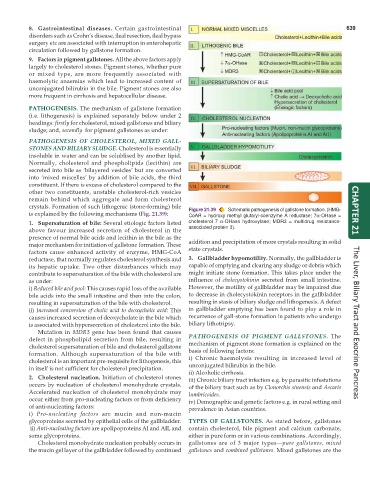
           PATHOGENESIS. The mechanism of gallstone formation
           (i.e. lithogenesis) is explained separately below under 2
           headings: firstly for cholesterol, mixed gallstones and biliary
           sludge; and, secondly  for pigment gallstones as under:
           PATHOGENESIS OF CHOLESTEROL, MIXED GALL-
           STONES AND BILIARY SLUDGE. Cholesterol is essentially
           insoluble in water and can be solublised by another lipid.
           Normally, cholesterol and phospholipids (lecithin) are
           secreted into bile as ‘bilayered vesicles’ but are converted
           into ‘mixed miscelles’ by addition of bile acids, the third
           constituent. If there is excess of cholesterol compared to the
           other two constituents, unstable cholesterol-rich vesicles
           remain behind which aggregate and form cholesterol
           crystals. Formation of such lithogenic (stone-forming) bile  Figure 21.39  Schematic pathogenesis of gallstone formation. (HMG-
           is explained by the following mechanisms (Fig. 21.39):  CoAR = hydroxy methyl glutaryl-coenzyme A reductase; 7α-OHase =  CHAPTER 21
           1. Supersaturation of bile: Several etiologic factors listed  cholesterol 7  α-OHase hydroxylase; MDR3 = multidrug resistance-
           above favour increased secretion of cholesterol in the  associated protein 3).
           presence of normal bile acids and lecithin in the bile as the
           major mechanism for initiation of gallstone formation. These  addition and precipitation of more crystals resulting in solid
           factors cause enhanced activity of enzyme, HMG-CoA  state crystals.
           reductase, that normally regulates cholesterol synthesis and  3. Gallbladder hypomotility. Normally, the gallbladder is
           its hepatic uptake. Two other disturbances which may  capable of emptying and clearing any sludge or debris which
           contribute to supersaturation of the bile with cholesterol are  might initiate stone formation. This takes place under the
           as under:                                           influence of cholecystokinin  secreted from small intestine.
           i) Reduced bile acid pool: This causes rapid loss of the available  However, the motility of gallbladder may be impaired due
           bile acids into the small intestine and then into the colon,  to decrease in cholecystokinin receptors in the gallbladder
           resulting in supersaturation of the bile with cholesterol.  resulting in stasis of biliary sludge and lithogenesis. A defect
           ii) Increased conversion of cholic acid to deoxycholic acid: This  in gallbladder emptying has been found to play a role in
           causes increased secretion of deoxycholate in the bile which  recurrence of gall-stone formation in patients who undergo
           is associated with hypersecretion of cholesterol into the bile.  biliary lithotripsy.                      The Liver, Biliary Tract and Exocrine Pancreas
              Mutation in  MDR3 gene has been found that causes
           defect in phospholipid secretion from bile, resulting in  PATHOGENESIS OF PIGMENT GALLSTONES.  The
           cholesterol supersaturation of bile and cholesterol gallstone  mechanism of pigment stone formation is explained on the
           formation. Although supersaturation of the bile with  basis of following factors:
           cholesterol is an important pre-requisite for lithogenesis, this  i) Chronic haemolysis resulting in increased level of
           in itself is not sufficient for cholesterol precipitation.  unconjugated bilirubin in the bile.
                                                               ii) Alcoholic cirrhosis.
           2. Cholesterol nucleation. Initiation of cholesterol stones  iii) Chronic biliary tract infection e.g. by parasitic infestations
           occurs by nucleation of cholesterol monohydrate crystals.  of the biliary tract such as by Clonorchis sinensis and Ascaris
           Accelerated nucleation of cholesterol monohydrate may  lumbricoides.
           occur either from pro-nucleating factors or from deficiency  iv) Demographic and genetic factors e.g. in rural setting and
           of anti-nucleating factors:                         prevalence in Asian countries.
           i)  Pro-nucleating factors are mucin and non-mucin
           glycoproteins secreted by epithelial cells of the gallbladder.  TYPES OF GALLSTONES. As stated before, gallstones
            ii) Anti-nucleating factors are apolipoproteins AI and AII, and  contain cholesterol, bile pigment and calcium carbonate,
           some glycoproteins.                                 either in pure form or in various combinations. Accordingly,
              Cholesterol monohydrate nucleation probably occurs in  gallstones are of 3 major types—pure gallstones, mixed
           the mucin gel layer of the gallbladder followed by continued  gallstones and combined gallstones. Mixed gallstones are the

