


Page 673 - Textbook of Pathology, 6th Edition
P. 673
neoplastic cystic lesions of the kidney are described later                                              657
           (page 694).

           I.  Multicystic Renal Dysplasia
           The term ‘multicystic renal dysplasia’ or Potter type II is used
           for disorganised metanephrogenic differentiation with
           persistence of structures in the kidney which are not
           represented in normal nephrogenesis.  Renal dysplasia is the
           most common form of cystic renal disease in the newborn
           and infants. The condition may occur sporadically or maybe
           familial and part of a syndrome of other anomalies. It is
           commonly associated with obstructive abnormalities of the
           ureter and lower urinary tract such as obstruction of
           pelviureteric junction (PUJ), ureteral atresia and urethral
           obstruction.

            MORPHOLOGIC FEATURES. Renal dysplasia may be
            unilateral or bilateral. The dysplastic process may involve
            the entire renal mass or a part of it.
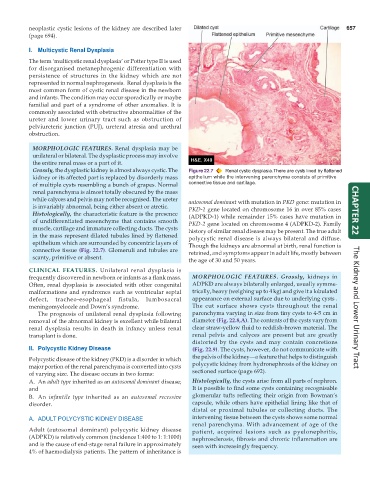
            Grossly, the dysplastic kidney is almost always cystic. The  Figure 22.7  Renal cystic dysplasia. There are cysts lined by flattened
            kidney or its affected part is replaced by disorderly mass  epithelium while the intervening parenchyma consists of primitive
            of multiple cysts resembling a bunch of grapes. Normal  connective tissue and cartilage.
            renal parenchyma is almost totally obscured by the mass
            while calyces and pelvis may not be recognised. The ureter  autosomal dominant with mutation in PKD gene: mutation in
            is invariably abnormal, being either absent or atretic.  PKD-1 gene located on chromosome 16 in over 85% cases
            Histologically, the characteristic feature is the presence  (ADPKD-1) while remainder 15% cases have mutation in  CHAPTER 22
            of undifferentiated mesenchyme that contains smooth  PKD-2 gene located on chromosome 4 (ADPKD-2). Family
            muscle, cartilage and immature collecting ducts. The cysts  history of similar renal disease may be present. The true adult
            in the mass represent dilated tubules lined by flattened  polycystic renal disease is always bilateral and diffuse.
            epithelium which are surrounded by concentric layers of  Though the kidneys are abnormal at birth, renal function is
            connective tissue (Fig. 22.7). Glomeruli and tubules are  retained, and symptoms appear in adult life, mostly between
            scanty, primitive or absent.                       the age of 30 and 50 years.

           CLINICAL FEATURES.  Unilateral renal dysplasia is
           frequently discovered in newborn or infants as a flank mass.  MORPHOLOGIC FEATURES.  Grossly, kidneys in
           Often, renal dysplasia is associated with other congenital  ADPKD are always bilaterally enlarged, usually symme-
           malformations and syndromes such as ventricular septal  trically, heavy (weighing up to 4 kg) and give it a lobulated
           defect, tracheo-esophageal fistula, lumbosacral       appearance on external surface due to underlying cysts .
           meningomyelocele and Down’s syndrome.                 The cut surface shows cysts throughout the renal     The Kidney and Lower Urinary Tract
              The prognosis of unilateral renal dysplasia following  parenchyma varying in size from tiny cysts to 4-5 cm in
           removal of the abnormal kidney is excellent while bilateral  diameter (Fig. 22.8,A). The contents of the cysts vary from
           renal dysplasia results in death in infancy unless renal  clear straw-yellow fluid to reddish-brown material. The
           transplant is done.                                   renal pelvis and calyces are present but are greatly
                                                                 distorted by the cysts and may contain concretions
           II. Polycystic Kidney Disease                         (Fig. 22.9). The cysts, however, do not communicate with
           Polycystic disease of the kidney (PKD) is a disorder in which  the pelvis of the kidney—a feature that helps to distinguish
           major portion of the renal parenchyma is converted into cysts  polycystic kidney from hydronephrosis of the kidney on
           of varying size. The disease occurs in two forms:     sectioned surface (page 692).
           A. An adult type inherited as an autosomal dominant disease;  Histologically, the cysts arise from all parts of nephron.
           and                                                   It is possible to find some cysts containing recognisable
                                                                 glomerular tufts reflecting their origin from Bowman’s
           B. An  infantile type inherited as an  autosomal recessive
           disorder.                                             capsule, while others have epithelial lining like that of
                                                                 distal or proximal tubules or collecting ducts. The
           A. ADULT POLYCYSTIC KIDNEY DISEASE                    intervening tissue between the cysts shows some normal
                                                                 renal parenchyma. With advancement of age of the
           Adult (autosomal dominant) polycystic kidney disease  patient, acquired lesions such as pyelonephritis,
           (ADPKD) is relatively common (incidence 1:400 to 1: 1:1000)  nephrosclerosis, fibrosis and chronic inflammation are
           and is the cause of end-stage renal failure in approximately  seen with increasingly frequency.
           4% of haemodialysis patients. The pattern of inheritance is

