


Page 674 - Textbook of Pathology, 6th Edition
P. 674
658                                                      berry aneurysms of the circle of Willis. Any acquired renal
                                                               disease is more prone to occur in polycystic kidneys.

                                                               B. INFANTILE POLYCYSTIC KIDNEY DISEASE
                                                               The infantile (autosomal recessive) form of polycystic kidney
                                                               disease (ARPKD) is distinct from the adult form and is less
                                                               common (incidence 1:20,000 births). It is transmitted as an
                                                               autosomal recessive trait and the family history of similar
                                                               disease is usually not present. The condition occurs due to a
                                                               mutation in chromosome 6—6p21, PKHD1 (polycystic kidney
                                                               and hepatic disease 1). It is invariably bilateral. The age at
                                                               presentation may be perinatal, neonatal, infantile or juvenile,
                                                               but frequently serious manifestations are present at birth and
                                                               result in death from renal failure in early childhood.

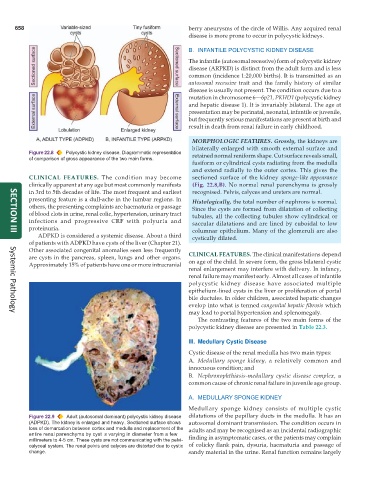
                                                                 MORPHOLOGIC FEATURES. Grossly, the kidneys are
                                                                 bilaterally enlarged with smooth external surface and
           Figure 22.8  Polycystic kidney disease. Diagrammatic representation  retained normal reniform shape. Cut surface reveals small,
           of comparison of gross appearance of the two main forms.
                                                                 fusiform or cylindrical cysts radiating from the medulla
                                                                 and extend radially to the outer cortex. This gives the
           CLINICAL FEATURES.  The condition may become          sectioned surface of the kidney  sponge-like appearance
           clinically apparent at any age but most commonly manifests  (Fig. 22.8,B). No normal renal parenchyma is grossly
           in 3rd to 5th decades of life. The most frequent and earliest  recognised. Pelvis, calyces and ureters are normal.
           presenting feature is a dull-ache in the lumbar regions. In  Histologically, the total number of nephrons is normal.
           others, the presenting complaints are haematuria or passage  Since the cysts are formed from dilatation of collecting
           of blood clots in urine, renal colic, hypertension, urinary tract  tubules, all the collecting tubules show cylindrical or
           infections and progressive CRF with polyuria and      saccular dilatations and are lined by cuboidal to low
           proteinuria.                                          columnar epithelium. Many of the glomeruli are also
              ADPKD is considered a systemic disease. About a third  cystically dilated.
     SECTION III
           of patients with ADPKD have cysts of the liver (Chapter 21).
           Other associated congenital anomalies seen less frequently
           are cysts in the pancreas, spleen, lungs and other organs.  CLINICAL FEATURES. The clinical manifestations depend
           Approximately 15% of patients have one or more intracranial  on age of the child. In severe form, the gross bilateral cystic
                                                               renal enlargement may interfere with delivery. In infancy,
                                                               renal failure may manifest early. Almost all cases of infantile
                                                               polycystic kidney disease have associated multiple
                                                               epithelium-lined cysts in the liver or proliferation of portal
                                                               bile ductules. In older children, associated hepatic changes
                                                               evelop into what is termed congenital hepatic fibrosis which
                                                               may lead to portal hypertension and splenomegaly.
     Systemic Pathology
                                                                  The contrasting features of the two main forms of the
                                                               polycystic kidney disease are presented in Table 22.3.

                                                               III. Medullary Cystic Disease
                                                               Cystic disease of the renal medulla has two main types:
                                                               A. Medullary sponge kidney, a relatively common and
                                                               innocuous condition; and
                                                               B. Nephronophthiasis-medullary cystic disease complex, a
                                                               common cause of chronic renal failure in juvenile age group.

                                                               A. MEDULLARY SPONGE KIDNEY

                                                               Medullary sponge kidney consists of multiple cystic
           Figure 22.9  Adult (autosomal dominant) polycystic kidney disease  dilatations of the papillary ducts in the medulla. It has an
           (ADPKD). The kidney is enlarged and heavy. Sectioned surface shows  autosomal dominant transmission. The condition occurs in
           loss of demarcation between cortex and medulla and replacement of the  adults and may be recognised as an incidental radiographic
           entire renal parenchyma by cyst s varying in diameter from a few  finding in asymptomatic cases, or the patients may complain
           millimeters to 4-5 cm. These cysts are not communicating with the pelvi-
           calyceal system. The renal pelvis and calyces are distorted due to cystic  of colicky flank pain, dysuria, haematuria and passage of
           change.                                             sandy material in the urine. Renal function remains largely

