


Page 677 - Textbook of Pathology, 6th Edition
P. 677
III.ACUTE RENAL FAILURE. As already described above, 661
TABLE 22.5: Causes of Acute Nephritic Syndrome.
acute renal failure (ARF) is characterised by rapid decline in
I. PRIMARY GLOMERULONEPHRITIS renal function. ARF has many causes including glomerular
1. Acute GN disease, principally rapidly progressive GN and acute diffuse
i) Post-streptococcal proliferative GN.
ii) Non-streptococcal
2. Rapidly progressive GN IV.CHRONIC RENAL FAILURE. Glomerular causes of
3. Membranoproliferative GN chronic renal failure (CRF) have already been described.
4. Focal GN
5. IgA nephropathy These cases have advanced renal impairment progressing
over years and is detected by significant proteinuria,
II. SYSTEMIC DISEASES haematuria, hypertension and azotaemia. Such patients
1. SLE generally have small contracted kidneys due to chronic
2. Polyarteritis nodosa glomerulonephritis.
3. Wegener’s granulomatosis
4. Henoch-Schonlein purpura V. ASYMPTOMATIC PROTEINURIA. Presence of
5. Cryoglobulinaemia
proteinuria unexpectedly in a patient may be unrelated to
renal disease (e.g. exercise-induced, extreme lordosis and
Often, the plasma albumin level is 1 to 3 gm/dl (normal 3.5 orthostatic proteinuria), or may indicate an underlying mild
to 5.5 gm/dl) and there is reversed albumin-globulin ratio. glomerulonephritis. Association of asymptomatic
The concentration of other proteins in the plasma such as haematuria, hypertension or impaired renal function with
immunoglobulins, clotting factors and antithrombin may fall asymptomatic proteinuria should raise strong suspicion of
rendering these patients more vulnerable to infections and underlying glomerulonephritis.
thrombotic and thromboembolic complications.
VI. ASYMPTOMATIC HAEMATURIA. Asymptomatic
3. Oedema in nephrotic syndrome appears due to fall in microscopic haematuria is common in children and young
colloid osmotic pressure consequent upon hypo-
albuminaemia. Sodium and water retention further TABLE 22.6: Causes of Nephrotic Syndrome.
contribute to oedema. Nephrotic oedema is usually CHAPTER 22
peripheral but in children facial oedema may be more I. PRIMARY GLOMERULONEPHRITIS
prominent (page 99). 1. Minimal change disease (most common in children)
2.
Membranous GN (most common in adults)
4. Hyperlipidaemia is a frequent accompaniment of 3. Membranoproliferative GN
nephrotic syndrome. The exact mechanism of its genesis is 4. Focal segmental glomerulosclerosis
not clear. It is hypothesised that the liver faced with the stress 5. Focal GN
of massive protein synthesis in response to heavy urinary 6. IgA nephropathy
protein loss, also causes increased synthesis of lipoproteins. II. SYSTEMIC DISEASES
There are increased blood levels of total lipids, cholesterol, 1. Diabetes mellitus
triglycerides, VLDL and LDL but decrease in HDL. Low 2. Amyloidosis
blood level of HDL is partly due to its loss in the urine. 3. SLE
5. Lipiduria occurs following hyperlipidaemia due to III. SYSTEMIC INFECTIONS
excessive leakiness of glomerular filtration barrier. 1. Viral infections (HBV, HCV, HIV)
2. Bacterial infections (bacterial endocarditis, syphilis, leprosy) The Kidney and Lower Urinary Tract
6. Hypercoagulability. Patients with nephrotic syndrome 3. Protozoa and parasites (P. falciparum malaria, filariasis)
may develop spontaneous arterial or venous thrombosis,
renal vein thrombosis and pulmonary embolism due to IV. HYPERSENSITIVITY REACTIONS
various factors. These include: increased urinary loss of 1. Drugs (heavy metal compounds like gold and mercury, other
drugs like penicillamine, trimethadione and tolbutamide,
antithrombin III, hyperfibrinogenaemia from increased heroin addiction)
synthesis in the liver, decreased fibrinolysis, increased 2. Bee stings, snake bite, poison ivy
platelet aggregation and altered levels of protein C and S. V. MALIGNANCY
The causes of nephrotic syndrome are diverse and are 1. Carcinomas
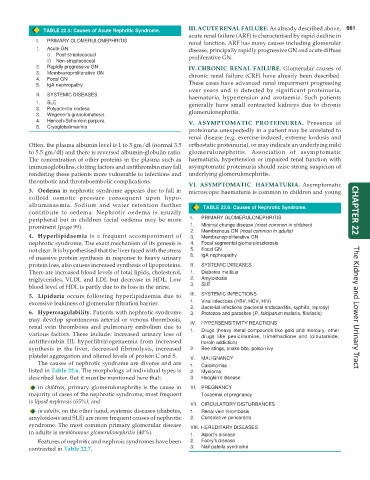
listed in Table 22.6. The morphology of individual types is 2. Myeloma
described later. But it must be mentioned here that: 3. Hodgkin’s disease
in children, primary glomerulonephritis is the cause in VI. PREGNANCY
majority of cases of the nephrotic syndrome; most frequent Toxaemia of pregnancy
is lipoid nephrosis (65%); and VII. CIRCULATORY DISTURBANCES
in adults, on the other hand, systemic diseases (diabetes, 1. Renal vein thrombosis
amyloidosis and SLE) are more frequent causes of nephrotic 2. Constrictive pericarditis
syndrome. The most common primary glomerular disease VIII. HEREDITARY DISEASES
in adults is membranous glomerulonephritis (40%). 1. Alport’s disease
Features of nephritic and nephroic syndromes have been 2. Fabry’s disease
contrasted in Table 22.7. 3. Nail-patella syndrome

