


Page 685 - Textbook of Pathology, 6th Edition
P. 685
minimal amounts of high molecular weight proteins such as  669
                                                               α2-macroglobulin. The basis for selective proteinuria appears
                                                               to be as under:
                                                               i) Reduction of normal negative charge on GBM (page 650)
                                                               due to loss of heparan sulfate proteoglycan from the GBM.
                                                               ii) Change in the shape of epithelial cells producing foot
                                                               process flattening due to reduction of sialoglycoprotein cell
                                                               coat.
                                                                  Adults having MCD, however, have non-selective protein-
                                                               uria,  suggesting more extensive membrane permeability
                                                               defect.

                                                                 MORPHOLOGIC FEATURES. Grossly, the kidneys are
                                                                 of normal size and shape.
                                                                 By light microscopy, the findings are as under
                                                                 (Fig. 22.16,A):
                                                                 i) Glomeruli—The most characteristic feature is no
                                                                 apparent abnormality in the glomeruli except for slight
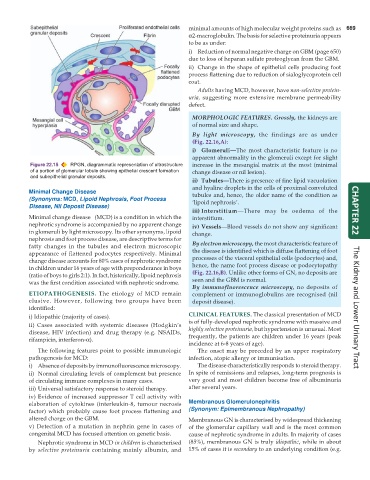
           Figure 22.15  RPGN, diagrammatic representation of ultrastructure  increase in the mesangial matrix at the most (minimal
           of a portion of glomerular lobule showing epithelial crescent formation  change disease or nil lesion).
           and subepithelial granular deposits.
                                                                 ii) Tubules—There is presence of fine lipid vacuolation
                                                                 and hyaline droplets in the cells of proximal convoluted
           Minimal Change Disease                                tubules and, hence, the older name of the condition as
           (Synonyms: MCD, Lipoid Nephrosis, Foot Process        ‘lipoid nephrosis’.
           Disease, Nil Deposit Disease)
                                                                 iii) Interstitium—There may be oedema of the         CHAPTER 22
           Minimal change disease   (MCD) is a condition in which the  interstitium.
           nephrotic syndrome is accompanied by no apparent change  iv) Vessels—Blood vessels do not show any significant
           in glomeruli by light microscopy. Its other synonyms, lipoid  change.
           nephrosis and foot process disease, are descriptive terms for
           fatty changes in the tubules and electron microscopic  By electron microscopy, the most characteristic feature of
           appearance of flattened podocytes respectively. Minimal  the disease is identified which is diffuse flattening of foot
           change disease accounts for 80% cases of nephrotic syndrome  processes of the visceral epithelial cells (podocytes) and,
           in children under 16 years of age with preponderance in boys  hence, the name foot process disease or podocytopathy
           (ratio of boys to girls 2:1). In fact, historically, lipoid nephrosis  (Fig. 22.16,B). Unlike other forms of GN, no deposits are
           was the first condition associated with nephrotic sndrome.  seen and the GBM is normal.
                                                                 By immunofluorescence microscopy, no deposits of
           ETIOPATHOGENESIS. The etiology of MCD remain          complement or immunoglobulins are recognised (nil
           elusive. However, following two groups have been      deposit disease).
           identified:                                                                                                The Kidney and Lower Urinary Tract
           i) Idiopathic (majority of cases).                  CLINICAL FEATURES. The classical presentation of MCD
           ii) Cases associated with systemic diseases (Hodgkin’s  is of fully-developed nephrotic syndrome with massive and
           disease, HIV infection) and drug therapy (e.g. NSAIDs,  highly selective proteinuria, but hypertension is unusual. Most
           rifampicin, interferon-α).                          frequently, the patients are children under 16 years (peak
                                                               incidence at 6-8 years of age).
              The following features point to possible immunologic  The onset may be preceded by an upper respiratory
           pathogenesis for MCD:                               infection, atopic allergy or immunisation.
           i) Absence of deposits by immunofluorescence microscopy.  The disease characteristically responds to steroid therapy.
           ii) Normal circulating levels of complement but presence  In spite of remissions and relapses, long-term prognosis is
           of circulating immune complexes in many cases.      very good and most children become free of albuminuria
           iii) Universal satisfactory response to steroid therapy.  after several years.
           iv) Evidence of increased suppressor T cell activity with
           elaboration of cytokines (interleukin-8, tumour necrosis  Membranous Glomerulonephritis
           factor) which probably cause foot process flattening and  (Synonym: Epimembranous Nephropathy)
           altered charge on the GBM.                          Membranous GN is characterised by widespread thickening
           v) Detection of a mutation in nephrin gene in cases of  of the glomerular capillary wall and is the most common
           congenital MCD has focused attention on genetic basis.  cause of nephrotic syndrome in adults. In majority of cases
              Nephrotic syndrome in MCD in children is characterised  (85%), membranous GN is truly idiopathic, while in about
           by  selective proteinuria containing mainly albumin, and  15% of cases it is secondary to an underlying condition (e.g.

