


Page 688 - Textbook of Pathology, 6th Edition
P. 688
672


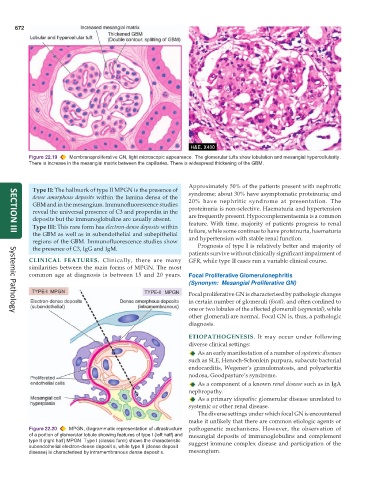
           Figure 22.19  Membranoproliferative GN, light microscopic appearance.  The glomerular tufts show lobulation and mesangial hypercellularity.
           There is increase in the mesangial matrix between the capillaries. There is widespread thickening of the GBM.


                                                               Approximately 50% of the patients present with nephrotic
            Type II: The hallmark of type II MPGN is the presence of  syndrome; about 30% have asymptomatic proteinuria; and
            dense amorphous deposits within the lamina densa of the  20% have nephritic syndrome at presentation. The
            GBM and in the mesangium. Immunofluorescence studies  proteinuria is non-selective. Haematuria and hypertension
            reveal the universal presence of C3 and properdin in the
            deposits but the immunoglobulins are usually absent.  are frequently present. Hypocomplementaemia is a common
            Type III: This rare form has electron-dense deposits within  feature. With time, majority of patients progress to renal
                                                               failure, while some continue to have proteinuria, haematuria
            the GBM as well as in subendothelial and subepithelial  and hypertension with stable renal function.
     SECTION III
            regions of the GBM. Immunofluorescence studies show
            the presence of C3, IgG and IgM.                      Prognosis of type I is relatively better and majority of
                                                               patients survive without clinically significant impairment of
           CLINICAL FEATURES.  Clinically, there are many      GFR, while type II cases run a variable clinical course.
           similarities between the main forms of MPGN. The most
           common age at diagnosis is between 15 and 20 years.  Focal Proliferative Glomerulonephritis
                                                               (Synonym:  Mesangial Proliferative GN)
                                                               Focal proliferative GN is characterised by pathologic changes
                                                               in certain number of glomeruli (focal), and often confined to
                                                               one or two lobules of the affected glomeruli (segmental), while
                                                               other glomeruli are normal. Focal GN is, thus, a pathologic
     Systemic Pathology
                                                               diagnosis.

                                                               ETIOPATHOGENESIS.  It may occur under following
                                                               diverse clinical settings:
                                                                  As an early manifestation of a number of systemic diseases
                                                               such as SLE, Henoch-Schonlein purpura, subacute bacterial
                                                               endocarditis, Wegener’s granulomatosis, and polyarteritis
                                                               nodosa, Goodpasture’s syndrome.
                                                                  As a component of a known renal disease such as in IgA
                                                               nephropathy.
                                                                  As a primary idiopathic glomerular disease unrelated to
                                                               systemic or other renal disease.
                                                                  The diverse settings under which focal GN is encountered
                                                               make it unlikely that there are common etiologic agents or
           Figure 22.20  MPGN, diagrammatic representation of ultrastructure  pathogenetic mechanisms. However, the observation of
           of a portion of glomerular lobule showing features of type I (left half) and  mesangial deposits of immunoglobulins and complement
           type II (right half) MPGN. Type I (classic form) shows the characteristic  suggest immune complex disease and participation of the
           subendothelial electron-dense deposit s, while type II (dense deposit
           disease) is characterised by intramembranous dense deposit s.  mesangium.

