


Page 689 - Textbook of Pathology, 6th Edition
P. 689
673


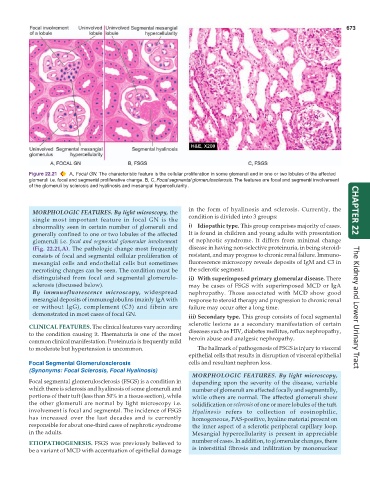
           Figure 22.21  A, Focal GN. The characteristic feature is the cellular proliferation in some glomeruli and in one or two lobules of the affected
           glomeruli i.e. focal and segmental proliferative change. B, C,  Focal segmental glomerulosclerosis. The features are focal and segmental involvement
           of the glomeruli by sclerosis and hyalinosis and mesangial hypercellularity .


                                                               in the form of hyalinosis and sclerosis. Currently, the
            MORPHOLOGIC FEATURES. By light microscopy, the     condition is divided into 3 groups:                    CHAPTER 22
            single most important feature in focal GN is the
            abnormality seen in certain number of glomeruli and  i) Idiopathic type. This group comprises majority of cases.
            generally confined to one or two lobules of the affected  It is found in children and young adults with presentation
            glomeruli i.e. focal and segmental glomerular involvement  of nephrotic syndrome. It differs from minimal change
            (Fig. 22.21,A). The pathologic change most frequently  disease in having non-selective proteinuria, in being steroid-
            consists of focal and segmental cellular proliferation of  resistant, and may progress to chronic renal failure. Immuno-
            mesangial cells and endothelial cells but sometimes  fluorescence microscopy reveals deposits of IgM and C3 in
            necrotising changes can be seen. The condition must be  the sclerotic segment.
            distinguished from focal and segmental glomerulo-  ii) With superimposed primary glomerular disease. There
            sclerosis (discussed below).                       may be cases of FSGS with superimposed MCD or IgA
            By immunofluorescence microscopy, widespread       nephropathy. Those associated with MCD show good
            mesangial deposits of immunoglobulins (mainly IgA with  response to steroid therapy and progression to chronic renal
            or without IgG), complement (C3) and fibrin are    failure may occur after a long time.                   The Kidney and Lower Urinary Tract
            demonstrated in most cases of focal GN.
                                                               iii) Secondary type. This group consists of focal segmental
           CLINICAL FEATURES. The clinical features vary according  sclerotic lesions as a secondary manifestation of certain
           to the condition causing it. Haematuria is one of the most  diseases such as HIV, diabetes mellitus, reflux nephropathy,
           common clinical manifestation. Proteinuria is frequently mild  heroin abuse and analgesic nephropathy.
           to moderate but hypertension is uncommon.              The hallmark of pathogenesis of FSGS is injury to visceral
                                                               epithelial cells that results in disruption of visceral epithelial
           Focal Segmental Glomerulosclerosis                  cells and resultant nephron loss.
           (Synonyms: Focal Sclerosis, Focal Hyalinosis)
                                                                 MORPHOLOGIC FEATURES. By light microscopy,
           Focal segmental glomerulosclerosis (FSGS) is a condition in  depending upon the severity of the disease, variable
           which there is sclerosis and hyalinosis of some glomeruli and  number of glomeruli are affected focally and segmentally,
           portions of their tuft (less than 50% in a tissue section), while  while others are normal. The affected glomeruli show
           the other glomeruli are normal by light microscopy i.e.  solidification or sclerosis of one or more lobules of the tuft.
           involvement is focal and segmental. The incidence of FSGS  Hyalinosis refers to collection of eosinophilic,
           has increased over the last decades and is currently  homogeneous, PAS-positive, hyaline material present on
           responsible for about one-third cases of nephrotic syndrome  the inner aspect of a sclerotic peripheral capillary loop.
           in the adults.                                        Mesangial hypercellularity is present in appreciable

           ETIOPATHOGENESIS. FSGS was previously believed to     number of cases. In addition, to glomerular changes, there
           be a variant of MCD with accentuation of epithelial damage  is interstitial fibrosis and infiltration by mononuclear

