


Page 686 - Textbook of Pathology, 6th Edition
P. 686
670


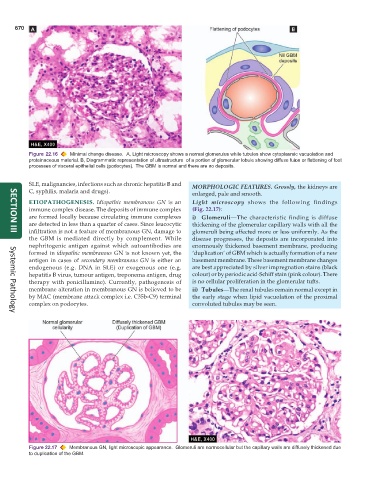
           Figure 22.16  Minimal change disease.  A, Light microscopy shows a normal glomerulus while tubules show cytoplasmic vacuolation and
           proteinaceous material. B, Diagrammatic representation of ultrastructure  of a portion of glomerular lobule showing diffuse fusion or flattening of foot
           processes of visceral epithelial cells (podocytes).  The GBM is normal and there are no deposits.

           SLE, malignancies, infections such as chronic hepatitis B and  MORPHOLOGIC FEATURES. Grossly, the kidneys are
           C, syphilis, malaria and drugs).                      enlarged, pale and smooth.
           ETIOPATHOGENESIS.  Idiopathic membranous  GN is an    Light microscopy shows the following findings
           immune complex disease. The deposits of immune complex  (Fig. 22.17):
           are formed locally because circulating immune complexes  i) Glomeruli—The characteristic finding is diffuse
           are detected in less than a quarter of cases. Since leucocytic  thickening of the glomerular capillary walls with all the
           infiltration is not a feature of membranous GN, damage to  glomeruli being affected more or less uniformly. As the
     SECTION III
           the GBM is mediated directly by complement. While     disease progresses, the deposits are incorporated into
           nephritogenic antigen against which autoantibodies are  enormously thickened basement membrane, producing
           formed in idiopathic membranous GN is not known yet, the  ‘duplication’ of GBM which is actually formation of a new
           antigen in cases of  secondary membranous GN is either an  basement membrane. These basement membrane changes
           endogenous (e.g. DNA in SLE) or exogenous one (e.g.   are best appreciated by silver impregnation stains (black
           hepatitis B virus, tumour antigen, treponema antigen, drug  colour) or by periodic acid-Schiff stain (pink colour). There
           therapy with penicillamine). Currently, pathogenesis of  is no cellular proliferation in the glomerular tufts.
           membrane alteration in membranous GN is believed to be  ii) Tubules—The renal tubules remain normal except in
           by MAC (membrane attack complex i.e. C35b-C9) terminal  the early stage when lipid vacuolation of the proximal
           complex on podocytes.                                 convoluted tubules may be seen.
     Systemic Pathology


           Figure 22.17  Membranous GN, light microscopic appearance.  Glomeruli are normocellular but the capillary walls are diffusely thickened due
           to duplication of the GBM.

