


Page 687 - Textbook of Pathology, 6th Edition
P. 687
increase in cellularity of the mesangium associated with  671
                                                               increased lobulation of the tuft, and irregular thickening of
                                                               the capillary wall.
                                                               ETIOPATHOGENESIS. Etiology of MPGN is unknown
                                                               though in some cases there is evidence of preceding
                                                               streptococcal infection. Based on ultrastructural,
                                                               immunofluorescence and pathogenetic mechanisms, three
                                                               types of MPGN are recognised:
                                                                  Type I or classic form is an example of immune complex
                                                               disease and comprises more than 70% cases. It is charac-
                                                               terised by immune deposits in the subendothelial position.
                                                               Immune-complex MPGN is seen in association with systemic
                                                               immune-complex diseases (e.g. SLE, mixed cryoglo-
                                                               bulinaemia, Sjögren’s syndrome), chronic infections (e.g.
                                                               bacterial endocarditis, HIV, hepatitis B and C) and
                                                               malignancies (e.g. lymphomas and leukaemias).
                                                                  Type II or dense deposit disease is the example of alter-
                                                               nate pathway disease (page 664) and constitutes about 30%
                                                               cases. The capillary wall thickening is due to the deposition
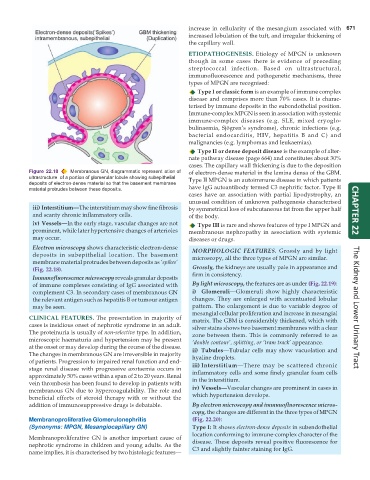
           Figure 22.18  Membranous GN, diagrammatic represent ation of  of electron-dense material in the lamina densa of the GBM.
           ultrastructure  of a portion of glomerular lobule showing subepithelial  Type II MPGN is an autoimmune disease in which patients
           deposits of electron-dense material so that the basement membrane
           material protrudes between these deposit s.         have IgG autoantibody termed C3 nephritic factor. Type II
                                                               cases have an association with partial lipodystrophy, an
                                                               unusual condition of unknown pathogenesis characterised
            iii) Interstitium—The interstitium may show fine fibrosis  by symmetrical loss of subcutaneous fat from the upper half
            and scanty chronic inflammatory cells.             of the body.                                           CHAPTER 22
            iv) Vessels—In the early stage, vascular changes are not  Type III is rare and shows features of type I MPGN and
            prominent, while later hypertensive changes of arterioles  membranous nephropathy in association with systemic
            may occur.                                         diseases or drugs.
            Electron microscopy shows characteristic electron-dense  MORPHOLOGIC FEATURES. Grossly and by light
            deposits in subepithelial location. The basement     microscopy, all the three types of MPGN are similar.
            membrane material protrudes between deposits as ‘spikes’
            (Fig. 22.18).                                        Grossly, the kidneys are usually pale in appearance and
            Immunofluorescence microscopy reveals granular deposits  firm in consistency.
            of immune complexes consisting of IgG associated with  By light microscopy, the features are as under (Fig. 22.19):
            complement C3. In secondary cases of membranous GN   i) Glomeruli—Glomeruli show highly characteristic
            the relevant antigen such as hepatitis B or tumour antigen  changes. They are enlarged with accentuated lobular
            may be seen.                                         pattern. The enlargement is due to variable degree of  The Kidney and Lower Urinary Tract
                                                                 mesangial cellular proliferation and increase in mesangial
           CLINICAL FEATURES. The presentation in majority of    matrix. The GBM is considerably thickened, which with
           cases is insidious onset of nephrotic syndrome in an adult.  silver stains shows two basement membranes with a clear
           The proteinuria is usually of non-selective type. In addition,  zone between them. This is commonly referred to as
           microscopic haematuria and hypertension may be present  ‘double contour’, splitting, or ‘tram track’ appearance.
           at the onset or may develop during the course of the disease.  ii) Tubules—Tubular cells may show vacuolation and
           The changes in membranous GN are irreversible in majority  hyaline droplets.
           of patients. Progression to impaired renal function and end-
           stage renal disease with progressive azotaemia occurs in  iii) Interstitium—There may be scattered chronic
           approximately 50% cases within a span of 2 to 20 years. Renal  inflammatory cells and some finely granular foam cells
           vein thrombosis has been found to develop in patients with  in the interstitium.
           membranous GN due to hypercoagulability. The role and  iv) Vessels—Vascular changes are prominent in cases in
           beneficial effects of steroid therapy with or without the  which hypertension develops.
           addition of immunosuppressive drugs is debatable.     By electron microscopy and immunofluorescence micros-
                                                                 copy, the changes are different in the three types of MPGN
           Membranoproliferative Glomerulonephritis              (Fig. 22.20):
           (Synonyms: MPGN, Mesangiocapillary GN)                Type I: It shows electron-dense deposits in subendothelial
                                                                 location conforming to immune-complex character of the
           Membranoproliferative GN is another important cause of
           nephrotic syndrome in children and young adults. As the  disease. These deposits reveal positive fluorescence for
           name implies, it is characterised by two histologic features—  C3 and slightly fainter staining for IgG.

