


Page 725 - Textbook of Pathology, 6th Edition
P. 725
TUMOUR MARKERS.  Germ cell tumours of the testis    45 years.  Testicular germ cell tumours are almost always  709
           secrete polypeptide hormones and certain enzymes which  malignant. Nearly half of them contain more than one
           can be detected in the blood. Two tumour markers widely  histologic type. Germ cell tumours are also found at the
           used in the diagnosis, staging and monitoring the follow-up  extragonadal sites such as the retroperitoneum and media-
           of patients with testicular tumours are: human chorionic  stinum, besides their counterparts in the female gonads (page
           gonadotropin (hCG) and alpha-foetoprotein (AFP). In  745).
           addition, carcinoembryonic antigen (CEA), human placental
           lactogen (HPL), placental alkaline phosphatase, testosterone,  Intratubular Germ Cell Neoplasia
           oestrogen and luteinising hormone may also be elevated.  The term intratubular germ cell neoplasia (ITGCN) is used
              hCG is synthesised by placental syncytio-trophoblast  to describe the preinvasive stage of germ cell tumours,
           such as in various non-seminomatous germ cell tumours of  notably intratubular seminoma and intratubular embryonal
           the testis (e.g. in choriocarcinoma, yolk sac tumour and  carcinoma. Others have used carcinoma in situ (CIS) stage
           embryonal carcinoma). However, ectopic hCG production  of germ cell tumours as synonymous term.
           may occur in a variety of non-testicular non-germ cell
           tumours as well.                                      Histologically, the malignant atypical tumour cells are
              AFP is normally synthesised by the foetal liver cells, yolk  restricted to the seminiferous tubules without evident
           sac and foetal gut. Its levels are elevated in testicular tumours  invasion into the interstitium.
           associated with yolk sac components. However, elevated
           serum AFP levels are also found in liver cell carcinoma.  Classic Seminoma

           PROGNOSIS. For selecting post-orchiectomy treatment  Seminoma is the commonest malignant tumour of the testis
           (radiation, surgery, chemotherapy or all the three) and for  and corresponds to dysgerminoma in the female (page 747).
           monitoring prognosis, 3 clinical stages are defined:  It constitutes about 45% of all germ cell tumours, and in
           Stage I: tumour confined to the testis.             another 15% comprises the major component of mixed germ
           Stage II: distant spread confined to retroperitoneal lymph  cell tumour. Seminoma is divided into 2 main categories:
           nodes below the diaphragm.                          classic and spermatocytic. Classic seminoma comprises about  CHAPTER 23
           Stage III: distant metastases beyond the retroperitoneal  93% of all seminomas and has a peak incidence in the 4th
           lymph nodes.                                        decade of life and is rare before puberty. Undescended testis
              Seminomas tend to remain localised to the testis (stage  harbours seminoma more frequently as compared to other
           I) while non-seminomatous germ cell tumours more often  germ cell tumours. About 10% pure seminomas are
           present with advanced clinical disease (stage II and III).  associated with elevated hCG levels in serum.
           Seminomas are extremely radiosensitive while non-
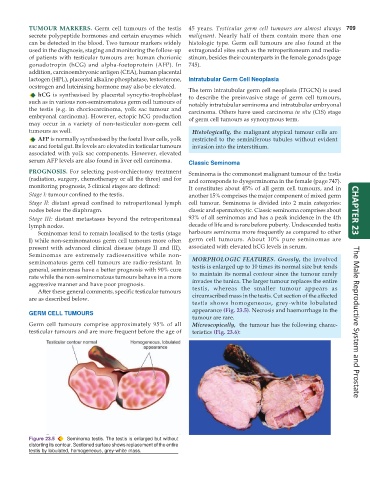
           seminomatous germ cell tumours are radio-resistant. In  MORPHOLOGIC FEATURES. Grossly, the involved
           general, seminomas have a better prognosis with 90% cure  testis is enlarged up to 10 times its normal size but tends
           rate while the non-seminomatous tumours behave in a more  to maintain its normal contour since the tumour rarely
           aggressive manner and have poor prognosis.            invades the tunica. The larger tumour replaces the entire
              After these general comments, specific testicular tumours  testis, whereas the smaller tumour appears as
           are as described below.                               circumscribed mass in the testis. Cut section of the affected
                                                                 testis shows homogeneous, grey-white lobulated
                                                                 appearance (Fig. 23.5). Necrosis and haemorrhage in the
           GERM CELL TUMOURS
                                                                 tumour are rare.
           Germ cell tumours comprise approximately 95% of all   Microscopically,  the tumour has the following charac-  The Male Reproductive System and Prostate
           testicular tumours and are more frequent before the age of  teristics (Fig. 23.6):


           Figure 23.5  Seminoma testis. The testis is enlarged but without
           distorting its contour. Sectioned surface shows replacement of the entire
           testis by lobulated, homogeneous, grey-white mass.

