


Page 726 - Textbook of Pathology, 6th Edition
P. 726
710


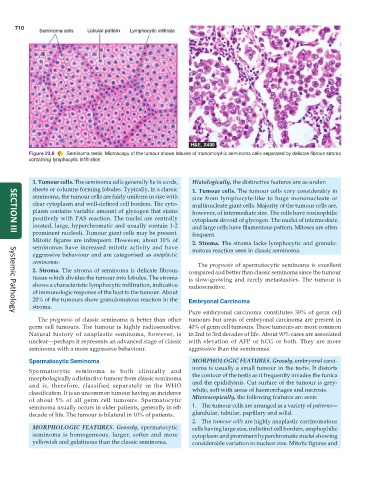
           Figure 23.6  Seminoma testis. Microscopy of the tumour shows lobules of monomorphic seminoma cells separated by delicate fibrous stroma
           containing lymphocytic infiltration.


            1. Tumour cells. The seminoma cells generally lie in cords,  Histologically, the distinctive features are as under:
            sheets or columns forming lobules. Typically, in a classic  1. Tumour cells. The tumour cells vary considerably in
            seminoma, the tumour cells are fairly uniform in size with  size from lymphocyte-like to huge mononucleate or
            clear cytoplasm and well-defined cell borders. The cyto-  multinucleate giant cells. Majority of the tumour cells are,
            plasm contains variable amount of glycogen that stains  however, of intermediate size. The cells have eosinophilic
            positively with PAS reaction. The nuclei are centrally  cytoplasm devoid of glycogen. The nuclei of intermediate
            located, large, hyperchromatic and usually contain 1-2  and large cells have filamentous pattern. Mitoses are often
            prominent nucleoli. Tumour giant cells may be present.  frequent.
     SECTION III
            Mitotic figures are infrequent. However, about 10% of  2. Stroma. The stroma lacks lymphocytic and granulo-
            seminomas have increased mitotic activity and have   matous reaction seen in classic seminoma.
            aggressive behaviour and are categorised as anaplastic
            seminomas.                                            The prognosis of spermatocytic seminoma is excellent
            2. Stroma. The stroma of seminoma is delicate fibrous  compared and better than classic seminoma since the tumour
            tissue which divides the tumour into lobules. The stroma  is slow-growing and rarely metastasises. The tumour is
            shows a characteristic lymphocytic infiltration, indicative  radiosensitive.
            of immunologic response of the host to the tumour. About
            20% of the tumours show granulomatous reaction in the  Embryonal Carcinoma
            stroma.
                                                               Pure embryonal carcinoma constitutes 30% of germ cell
     Systemic Pathology
              The prognosis of classic seminoma is better than other  tumours but areas of embryonal carcinoma are present in
           germ cell tumours. The tumour is highly radiosensitive.  40% of germ cell tumours. These tumours are more common
           Natural history of anaplastic seminoma, however, is  in 2nd to 3rd decades of life. About 90% cases are associated
           unclear—perhaps it represents an advanced stage of classic  with elevation of AFP or hCG or both. They are more
           seminoma with a more aggressive behaviour.          aggressive than the seminomas.

           Spermatocytic Seminoma                                MORPHOLOGIC FEATURES. Grossly, embryonal carci-
                                                                 noma is usually a small tumour in the testis. It distorts
           Spermatocytic seminoma is both clinically and
           morphologically a distinctive tumour from classic seminoma  the contour of the testis as it frequently invades the tunica
           and is, therefore, classified separately in the WHO   and the epididymis. Cut surface of the tumour is grey-
           classification. It is an uncommon tumour having an incidence  white, soft with areas of haemorrhages and necrosis.
           of about 5% of all germ cell tumours. Spermatocytic   Microscopically, the following features are seen:
           seminoma usually occurs in older patients, generally in 6th  1. The tumour cells are arranged in a variety of patterns—
           decade of life. The tumour is bilateral in 10% of patients.  glandular, tubular, papillary and solid.
                                                                 2. The tumour cells are highly anaplastic carcinomatous
            MORPHOLOGIC FEATURES. Grossly, spermatocytic         cells having large size, indistinct cell borders, amphophilic
            seminoma is homogeneous, larger, softer and more     cytoplasm and prominent hyperchromatic nuclei showing
            yellowish and gelatinous than the classic seminoma.  considerable variation in nuclear size. Mitotic figures and

