


Page 740 - Textbook of Pathology, 6th Edition
P. 740
724 of the vagina are rare and include carcinoma (squamous cell The tumour invades extensively in the pelvis and
carcinoma and adenocarcinoma) and embryonal metastasises to regional lymph nodes and distant sites such
rhabdomyosarcoma (sarcoma botyroides). as to lungs and liver. Radical surgery combined with
chemotherapy offers some benefit.
Carcinoma of Vagina
Primary carcinoma of the vagina is an uncommon tumour. CERVIX
Squamous cell dysplasia or vaginal intraepithelial neoplasia NORMAL STRUCTURE
occur less frequently as compared to the cervix or vulva and
can be detected by Pap smears as discussed in Chapter 11. The cervix consists of an internal os communicating with the
Invasive carcinoma of the vagina includes two main types: endometrial cavity above, and an external os opening into
1. Squamous cell carcinoma of vagina constitutes less than the vagina below. Ectocervix (exocervix) or portio vaginalis is
2% of all gynaecologic malignancies and is similar in the part of the cervix exposed to the vagina and is lined by
morphology as elsewhere in the female genital tract. The role stratified squamous epithelium, whereas the endocervix is
of HPV types 16 and 18 in its etiology and the possibility of continuous with the endocervical canal and is lined by a
an extension from cervical carcinoma to the vagina have been single layer of tall columnar mucus-secreting epithelium. The
emphasised. endocervical mucosa is thrown into folds resulting in
formation of clefts and tunnels, commonly referred to as
2. Adenocarcinoma of the vagina is much less than cervical glands that secrete mucus. The junction of the
squamous cell carcinoma of the vagina. It may be endo- ectocervix and endocervix—junctional mucosa, consists of
metrioid or mucinous type. The significance of association gradual transition between squamous and columnar
of diethylstilbestrol administered during pregnancy to the epithelia (squamo-columnar junction) and is clinically and
mother with development of adenocarcinoma of the vagina pathologically significant landmark. The cervical mucosa
in the daughter has been discussed in Chapter 8. undergoes changes under the influence of hormones and
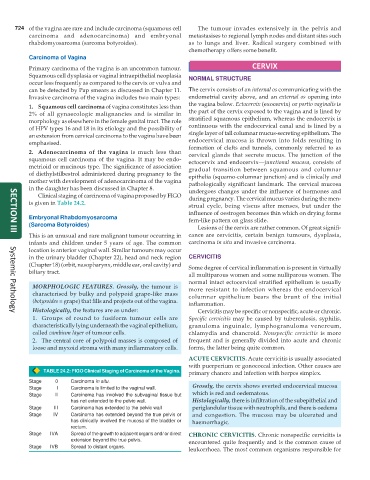
Clinical staging of carcinoma of vagina proposed by FIGO during pregnancy. The cervical mucus varies during the men-
is given in Table 24.2.
strual cycle, being viscus after menses, but under the
influence of oestrogen becomes thin which on drying forms
Embryonal Rhabdomyosarcoma fern-like pattern on glass slide.
(Sarcoma Botyroides)
Lesions of the cervix are rather common. Of great signifi-
This is an unusual and rare malignant tumour occurring in cance are cervicitis, certain benign tumours, dysplasia,
SECTION III
infants and children under 5 years of age. The common carcinoma in situ and invasive carcinoma.
location is anterior vaginal wall. Similar tumours may occur
in the urinary bladder (Chapter 22), head and neck region CERVICITIS
(Chapter 18) (orbit, nasopharynx, middle ear, oral cavity) and Some degree of cervical inflammation is present in virtually
biliary tract.
all multiparous women and some nulliparous women. The
normal intact ectocervical stratified epithelium is usually
MORPHOLOGIC FEATURES. Grossly, the tumour is more resistant to infection whereas the endocervical
characterised by bulky and polypoid grape-like mass columnar epithelium bears the brunt of the initial
(botyroides = grape) that fills and projects out of the vagina.
inflammation.
Histologically, the features are as under: Cervicitis may be specific or nonspecific, acute or chronic.
Systemic Pathology
1. Groups of round to fusiform tumour cells are Specific cervicitis may be caused by tuberculosis, syphilis,
characteristically lying underneath the vaginal epithelium, granuloma inguinale, lymphogranuloma venereum,
called cambium layer of tumour cells. chlamydia and chancroid. Nonspecific cervicitis is more
2. The central core of polypoid masses is composed of frequent and is generally divided into acute and chronic
loose and myxoid stroma with many inflammatory cells. forms, the latter being quite common.
ACUTE CERVICITIS. Acute cervicitis is usually associated
with puerperium or gonococcal infection. Other causes are
TABLE 24.2: FIGO Clinical Staging of Carcinoma of the Vagina. primary chancre and infection with herpes simplex.
Stage 0 Carcinoma in situ.
Stage I Carcinoma is limited to the vaginal wall. Grossly, the cervix shows everted endocervical mucosa
Stage II Carcinoma has involved the subvaginal tissue but which is red and oedematous.
has not extended to the pelvic wall. Histologically, there is infiltration of the subepithelial and
Stage III Carcinoma has extended to the pelvic wall periglandular tissue with neutrophils, and there is oedema
Stage IV Carcinoma has extended beyond the true pelvis or and congestion. The mucosa may be ulcerated and
has clinically involved the mucosa of the bladder or haemorrhagic.
rectum.
Stage IVA Spread of the growth to adjacent organs and/ or direct CHRONIC CERVICITIS. Chronic nonspecific cervicitis is
extension beyond the true pelvis. encountered quite frequently and is the common cause of
Stage IVB Spread to distant organs.
leukorrhoea. The most common organisms responsible for

