


Page 761 - Textbook of Pathology, 6th Edition
P. 761
tiating towards endometrial type of epithelium. In view of  carcinoma i.e. clear cells having abundant eosinophilic  745
           presence of endometriosis in a few cases of endometrioid  cytoplasm rich in glycogen.
           tumours, some authors have suggested malignant trans-
           formation of endometriosis.                         Brenner Tumour
            MORPHOLOGIC FEATURES. Grossly, these tumours       Brenner tumours are uncommon and comprise about 2% of
            are partly solid and partly cystic and may have foci of  all ovarian tumours. They are characteristically solid ovarian
            haemorrhages, especially in benign variety.        tumours. Less than 10% of Brenner tumours are bilateral.
            Histologically, the endometrioid adenocarcinoma is  Most Brenner tumours are benign. Rarely, borderline form
            distinguished from serous and mucinous carcinomas by  is encountered called ‘proliferating Brenner tumour’ while
            typical glandular pattern that closely resembles that of  the one with carcinomatous change is termed ‘malignant
            uterine endometrioid adenocarcinoma. There may be foci  Brenner tumour’.
            of squamous metaplasia justifying the diagnosis of    Histogenesis of the tumour is from coelomic epithelium
            adenoacanthoma. Papillary pattern and foci of serous and  by metaplastic transformation into transitional epithelium
            mucinous carcinoma may also be found. Benign variety  (urothelium).
            closely resembles endometriosis with cystic change. There
            are no clearly defined criteria for borderline endometrioid  MORPHOLOGIC FEATURES. Grossly, Brenner tumour
            tumours.                                             is typically solid, yellow-grey, firm mass of variable size.
                                                                 Occasionally, a few scattered tiny cysts may be present
           Clear Cell (Mesonephroid) Tumours                     on cut section.
           Clear cell (mesonephroid) tumours are almost always   Histologically, Brenner tumour consists of nests, masses
           malignant and comprise about 5% of all ovarian cancers; rare  and columns of epithelial cells, scattered in fibrous stroma
           benign variety is called clear cell adenofibroma. They are termed  of the ovary. These epithelial cells resemble urothelial cells
           clear cell or mesonephroid carcinomas because of the close  which are ovoid in shape, having clear cytoplasm,
           histologic resemblance to renal adenocarcinoma. They have  vesicular nuclei with characteristic nuclear groove called
           also been called as mesonephroma or mesonephric carcinoma  ‘coffee-bean’ nuclei.
           because of the questionable relationship to the mesonephric                                                CHAPTER 24
           structures.                                         II. GERM CELL TUMOURS
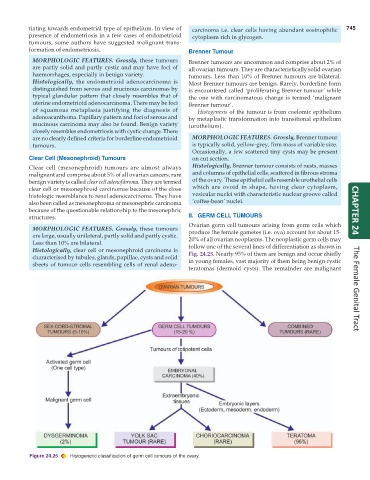
                                                               Ovarian germ cell tumours arising from germ cells which
            MORPHOLOGIC FEATURES. Grossly, these tumours       produce the female gametes (i.e. ova) account for about 15-
            are large, usually unilateral, partly solid and partly cystic.  20% of all ovarian neoplasms. The neoplastic germ cells may
            Less than 10% are bilateral.                       follow one of the several lines of differentiation as shown in
            Histologically, clear cell or mesonephroid carcinoma is  Fig. 24.25. Nearly 95% of them are benign and occur chiefly
            characterised by tubules, glands, papillae, cysts and solid
            sheets of tumour cells resembling cells of renal adeno-  in young females, vast majority of them being benign cystic
                                                               teratomas (dermoid cysts). The remainder are malignant  The Female Genital Tract


           Figure 24.25  Histogenetic classification of germ cell tumours of the ovary.

