


Page 762 - Textbook of Pathology, 6th Edition
P. 762
746


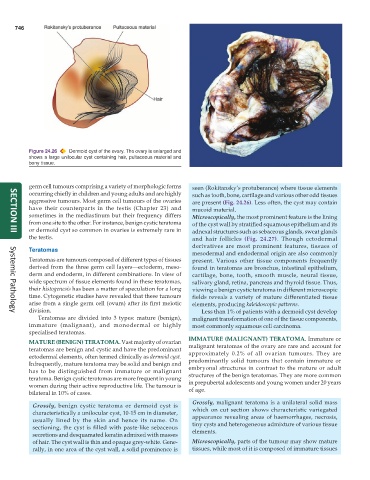
           Figure 24.26  Dermoid cyst of the ovary. The ovary is enlarged and
           shows a large unilocular cyst containing hair, pultaceous material and
           bony tissue.


           germ cell tumours comprising a variety of morphologic forms  seen (Rokitansky’s protuberance) where tissue elements
           occurring chiefly in children and young adults and are highly  such as tooth, bone, cartilage and various other odd tissues
           aggressive tumours. Most germ cell tumours of the ovaries  are present (Fig. 24.26). Less often, the cyst may contain
           have their counterparts in the testis (Chapter 23) and  mucoid material.
           sometimes in the mediastinum but their frequency differs  Microscopically, the most prominent feature is the lining
           from one site to the other. For instance, benign cystic teratoma  of the cyst wall by stratified squamous epithelium and its
           or dermoid cyst so common in ovaries is extremely rare in  adnexal structures such as sebaceous glands, sweat glands
     SECTION III
           the testis.                                           and hair follicles  (Fig. 24.27). Though ectodermal
                                                                 derivatives are most prominent features, tissues of
           Teratomas
                                                                 mesodermal and endodermal origin are also commonly
           Teratomas are tumours composed of different types of tissues  present. Various other tissue components frequently
           derived from the three germ cell layers—ectoderm, meso-  found in teratomas are bronchus, intestinal epithelium,
           derm and endoderm, in different combinations. In view of  cartilage, bone, tooth, smooth muscle, neural tissue,
           wide spectrum of tissue elements found in these teratomas,  salivary gland, retina, pancreas and thyroid tissue. Thus,
           their histogenesis has been a matter of speculation for a long  viewing a benign cystic teratoma in different microscopic
           time. Cytogenetic studies have revealed that these tumours  fields reveals a variety of mature differentiated tissue
           arise from a single germ cell (ovum) after its first meiotic  elements, producing kaleidoscopic patterns.
           division.                                                Less than 1% of patients with a dermoid cyst develop
     Systemic Pathology
              Teratomas are divided into 3 types: mature (benign),  malignant transformation of one of the tissue components,
           immature (malignant), and monodermal or highly        most commonly squamous cell carcinoma.
           specialised teratomas.
                                                               IMMATURE (MALIGNANT) TERATOMA. Immature or
           MATURE (BENIGN) TERATOMA. Vast majority of ovarian  malignant teratomas of the ovary are rare and account for
           teratomas are benign and cystic and have the predominant  approximately 0.2% of all ovarian tumours. They are
           ectodermal elements, often termed clinically as dermoid cyst.  predominantly solid tumours that contain immature or
           Infrequently, mature teratoma may be solid and benign and  embryonal structures in contrast to the mature or adult
           has to be distinguished from immature or malignant  structures of the benign teratomas. They are more common
           teratoma. Benign cystic teratomas are more frequent in young  in prepubertal adolescents and young women under 20 years
           women during their active reproductive life. The tumour is  of age.
           bilateral in 10% of cases.
                                                                 Grossly, malignant teratoma is a unilateral solid mass
            Grossly, benign cystic teratoma or dermoid cyst is
            characteristically a unilocular cyst, 10-15 cm in diameter,  which on cut section shows characteristic variegated
            usually lined by the skin and hence its name. On     appearance revealing areas of haemorrhages, necrosis,
            sectioning, the cyst is filled with paste-like sebaceous  tiny cysts and heterogeneous admixture of various tissue
            secretions and desquamated keratin admixed with masses  elements.
            of hair. The cyst wall is thin and opaque grey-white. Gene-  Microscopically, parts of the tumour may show mature
            rally, in one area of the cyst wall, a solid prominence is  tissues, while most of it is composed of immature tissues

