


Page 763 - Textbook of Pathology, 6th Edition
P. 763
747


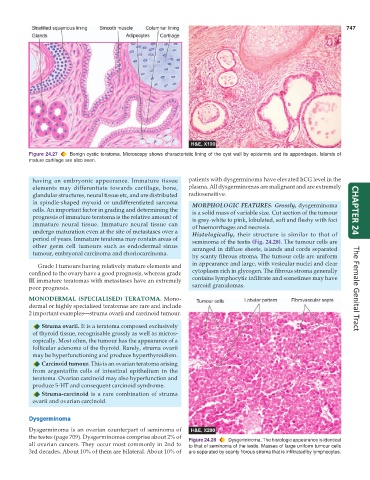
           Figure 24.27  Benign cystic teratoma. Microscopy shows characteristic lining of the cyst wall by epidermis and its appendages. Islands of
           mature cartilage are also seen.


            having an embryonic appearance. Immature tissue    patients with dysgerminoma have elevated hCG level in the
            elements may differentiate towards cartilage, bone,  plasma. All dysgerminomas are malignant and are extremely
            glandular structures, neural tissue etc, and are distributed  radiosensitive.
            in spindle-shaped myxoid or undifferentiated sarcoma  MORPHOLOGIC FEATURES. Grossly, dysgerminoma
            cells. An important factor in grading and determining the  is a solid mass of variable size. Cut section of the tumour  CHAPTER 24
            prognosis of immature teratoma is the relative amount of  is grey-white to pink, lobulated, soft and fleshy with foci
            immature neural tissue. Immature neural tissue can   of haemorrhages and necrosis.
            undergo maturation even at the site of metastases over a  Histologically, their structure is similar to that of
            period of years. Immature teratoma may contain areas of  seminoma of the testis (Fig. 24.28). The tumour cells are
            other germ cell tumours such as endodermal sinus     arranged in diffuse sheets, islands and cords separated
            tumour, embryonal carcinoma and choriocarcinoma.
                                                                 by scanty fibrous stroma. The tumour cells are uniform
              Grade I tumours having relatively mature elements and  in appearance and large, with vesicular nuclei and clear
           confined to the ovary have a good prognosis, whereas grade  cytoplasm rich in glycogen. The fibrous stroma generally
           III immature teratomas with metastases have an extremely  contains lymphocytic infiltrate and sometimes may have
           poor prognosis.                                       sarcoid granulomas.                                  The Female Genital Tract
           MONODERMAL (SPECIALISED) TERATOMA. Mono-
           dermal or highly specialised teratomas are rare and include
           2 important examples—struma ovarii and carcinoid tumour.
               Struma ovarii. It is a teratoma composed exclusively
            of thyroid tissue, recognisable grossly as well as micros-
            copically. Most often, the tumour has the appearance of a
            follicular adenoma of the thyroid. Rarely, struma ovarii
            may be hyperfunctioning and produce hyperthyroidism.
               Carcinoid tumour. This is an ovarian teratoma arising
            from argentaffin cells of intestinal epithelium in the
            teratoma. Ovarian carcinoid may also hyperfunction and
            produce 5-HT and consequent carcinoid syndrome.
               Struma-carcinoid  is a rare combination of struma
            ovarii and ovarian carcinoid.


           Dysgerminoma
           Dysgerminoma is an ovarian counterpart of seminoma of
           the testes (page 709). Dysgerminomas comprise about 2% of  Figure 24.28  Dysgerminoma. The histologic appearance is identical
           all ovarian cancers. They occur most commonly in 2nd to  to that of seminoma of the testis. Masses of large uniform tumour cells
           3rd decades. About 10% of them are bilateral. About 10% of  are separated by scanty fibrous stroma that is infiltrated by lymphocytes.

