


Page 77 - Textbook of Pathology, 6th Edition
P. 77
61
                                                     Immunopathology
            Chapter 4
            Chapter 4
                                                 Including Amyloidosis                                                CHAPTER 4


                                                                   Natural or innate immunity is  non-specific and is
                           INTRODUCTION
                                                               considered as the first line of defense without antigenic
           Immunity and immunopathology are proverbial two edges  specificity. It has 2 major components:
           of ‘double-edged sword’.                            a) Humoral: comprised by complement.
              Before discussing immunopathology which is the study  b) Cellular: consists of neutrophils, macrophages, and
           of derangements in the immune system, it is important to  natural killer (NK) cells.
           know the normal structure and function of the immune    Specific or adaptive immunity is  specific and is
           system (immunophysiology) and to get familiarised with a  characterised by antigenic specificity. It too has 2 main
           few terms and definitions commonly used in any description  components:
           of immunology.                                      a) Humoral: consisting of antibodies formed by B cells.
              An antigen (Ag) is defined as a substance, usually protein  b) Cellular: mediated by T cells.
           in nature, which when introduced into the tissues stimulates  The various components of both types of immunity are  Immunopathology Including Amyloidosis
           antibody production.                                interdependent and interlinked for their functions.
              Hapten is a non-protein substance which has no antigenic
           properties, but on combining with a protein can form a new  STRUCTURE OF IMMUNE SYSTEM
           antigen capable of forming antibodies.
                                                               ORGANS OF IMMUNE SYSTEM
              An antibody (Ab) is a protein substance produced as a
           result of antigenic stimulation. Circulating antibodies are  Although functioning as a system, the organs of immune
           immunoglobulins (Igs) of which there are 5 classes: IgG, IgA,  system are distributed at different places in the body.  These
           IgM, IgE and IgD.                                   are as under:
              An antigen may induce  specifically sensitised cells  a) Primary lymphoid organs:
           having the capacity to recognise, react and neutralise the  i) Thymus
           injurious agent or organisms.                       ii) Bone marrow
              The antigen may combine with antibody to form antigen-  b) Secondary lymphoid organs:
           antibody complex. The reaction of Ag with Ab in vitro may  i) Lymph nodes
           be primary or secondary phenomena; the secondary reaction  ii) Spleen
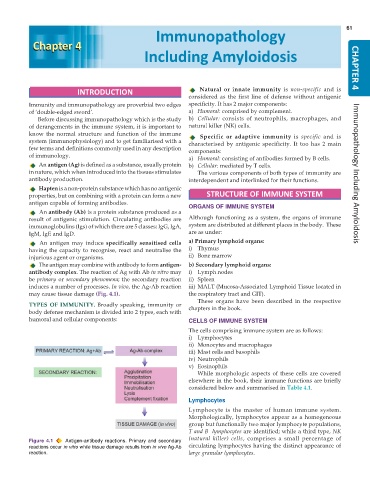
           induces a number of processes. In vivo, the Ag-Ab reaction  iii) MALT (Mucosa-Associated Lymphoid Tissue located in
           may cause tissue damage (Fig. 4.1).                 the respiratory tract and GIT).
                                                                  These organs have been described in the respective
           TYPES OF IMMUNITY. Broadly speaking, immunity or    chapters in the book.
           body defense mechanism is divided into 2 types, each with
           humoral and cellular components:                    CELLS OF IMMUNE SYSTEM
                                                               The cells comprising immune system are as follows:
                                                               i) Lymphocytes
                                                               ii) Monocytes and macrophages
                                                               iii) Mast cells and basophils
                                                               iv) Neutrophils
                                                               v) Eosinophils
                                                                  While morphologic aspects of these cells are covered
                                                               elsewhere in the book, their immune functions are briefly
                                                               considered below and summarised in Table 4.1.

                                                               Lymphocytes
                                                               Lymphocyte is the master of human immune system.
                                                               Morphologically, lymphocytes appear as a homogeneous
                                                               group but functionally two major lymphocyte populations,
                                                               T and B  lymphocytes are identified; while a third type, NK
                                                               (natural killer) cells, comprises a small percentage of
           Figure 4.1  Antigen-antibody reactions. Primary and secondary
           reactions occur in vitro while tissue damage results from in vivo Ag-Ab  circulating lymphocytes having the distinct appearance of
           reaction.                                           large granular lymphocytes.

