


Page 81 - Textbook of Pathology, 6th Edition
P. 81
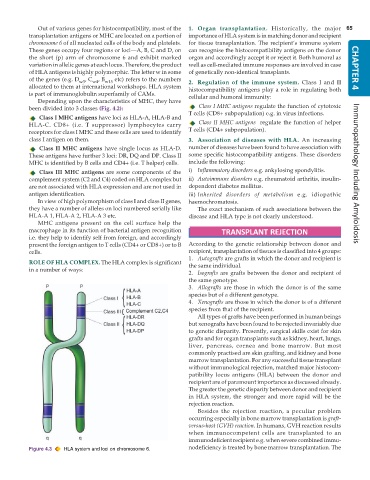
Out of various genes for histocompatibility, most of the  1. Organ transplantation.  Historically, the major  65
           transplantation antigens or MHC are located on a portion of  importance of HLA system is in matching donor and recipient
           chromosome 6 of all nucleated cells of the body and platelets.  for tissue transplantation. The recipient’s immune system
           These genes occupy four regions or loci—A, B, C and D, on  can recognise the histocompatibility antigens on the donor
           the short (p) arm of chromosome 6 and exhibit marked  organ and accordingly accept it or reject it. Both humoral as
           variation in allelic genes at each locus. Therefore, the product  well as cell-mediated immune responses are involved in case
           of HLA antigens is highly polymorphic. The letter w in some  of genetically non-identical transplants.     CHAPTER 4
           of the genes (e.g. D w3 , C w4 , B w15  etc) refers to the numbers  2. Regulation of the immune system.  Class I and II
           allocated to them at international workshops. HLA system  histocompatibility antigens play a role in regulating both
           is part of immunoglobulin superfamily of CAMs.      cellular and humoral immunity:
              Depending upon the characteristics of MHC, they have
           been divided into 3 classes (Fig. 4.2):                 Class I MHC antigens regulate the function of cytotoxic
                                                               T cells (CD8+ subpopulation) e.g. in virus infections.
              Class I MHC antigens have loci as HLA-A, HLA-B and
           HLA-C. CD8+ (i.e. T suppressor) lymphocytes carry       Class II MHC antigens  regulate the function of helper
           receptors for class I MHC and these cells are used to identify  T cells (CD4+ subpopulation).
           class I antigen on them.                            3. Association of diseases with HLA.  An increasing
              Class II MHC antigens have single locus as HLA-D.  number of diseases have been found to have association with
           These antigens have further 3 loci: DR, DQ and DP. Class II  some specific histocompatibility antigens. These disorders
           MHC is identified by B cells and CD4+ (i.e. T helper) cells.  include the following:
              Class III MHC antigens are some components of the  i) Inflammatory disorders e.g. ankylosing spondylitis.  Immunopathology Including Amyloidosis
           complement system (C2 and C4) coded on HLA complex but  ii) Autoimmune disorders e.g. rheumatoid arthritis, insulin-
           are not associated with HLA expression and are not used in  dependent diabetes mellitus.
           antigen identification.                             iii) Inherited disorders of metabolism e.g. idiopathic
              In view of high polymorphism of class I and class II genes,  haemochromatosis.
           they have a number of alleles on loci numbered serially like  The exact mechanism of such associations between the
           HLA-A 1, HLA-A 2, HLA-A 3 etc.                      disease and HLA type is not clearly understood.
              MHC antigens present on the cell surface help the
           macrophage in its function of bacterial antigen recognition    TRANSPLANT REJECTION
           i.e. they help to identify self from foreign, and accordingly
           present the foreign antigen to T cells (CD4+ or CD8+) or to B  According to the genetic relationship between donor and
           cells.                                              recipient, transplantation of tissues is classified into 4 groups:
                                                               1. Autografts are grafts in which the donor and recipient is
           ROLE OF HLA COMPLEX. The HLA complex is significant  the same individual.
           in a number of ways:
                                                               2. Isografts are grafts between the donor and recipient of
                                                               the same genotype.
                                                               3. Allografts are those in which the donor is of the same
                                                               species but of a different genotype.
                                                               4. Xenografts are those in which the donor is of a different
                                                               species from that of the recipient.
                                                                  All types of grafts have been performed in human beings
                                                               but xenografts have been found to be rejected invariably due
                                                               to genetic disparity. Presently, surgical skills exist for skin
                                                               grafts and for organ transplants such as kidney, heart, lungs,
                                                               liver, pancreas, cornea and bone marrow. But most
                                                               commonly practised are skin grafting, and kidney and bone
                                                               marrow transplantation. For any successful tissue transplant
                                                               without immunological rejection, matched major histocom-
                                                               patibility locus antigens (HLA) between the donor and
                                                               recipient are of paramount importance as discussed already.
                                                               The greater the genetic disparity between donor and recipient
                                                               in HLA system, the stronger and more rapid will be the
                                                               rejection reaction.
                                                                  Besides the rejection reaction, a peculiar problem
                                                               occurring especially in bone marrow transplantation is graft-
                                                               versus-host (GVH) reaction. In humans, GVH reaction results
                                                               when immunocompetent cells are transplanted to an
                                                               immunodeficient recipient e.g. when severe combined immu-
           Figure 4.3  HLA system and loci on chromosome 6.    nodeficiency is treated by bone marrow transplantation. The

