


Page 79 - Textbook of Pathology, 6th Edition
P. 79
antigen-presenting cell such as dendritic cell, and the major  receptor (TCR) for recognition of MHC molecules. Depending  63
           histocompatibilty complex (MHC) in the macrophage, which  upon functional activity, T cells have two major subtypes: T
           determines whether the invading antigen is to be presented  helper cells and T suppressor cells.
           to B cells or T cells. Some strong antigens that cannot be dealt  T helper cells. Abbreviated as T  cells, these cells promote
                                                                                           H
           by antibody response from B cells such as certain   and enhance the immune reaction and are also termed as
           microorganisms (e.g. viruses, mycobacteria M. tuberculosis  T-regulatory cells. They carry CD4 molecule on their surface
           and M. leprae), cancer cells, tissue transplantation antigen etc,  and hence are also called CD4+ cells. CD4+ cells in circulation  CHAPTER 4
           are presented to T cells.                           are about twice the number of CD8+ cells (CD4+/CD8 ratio
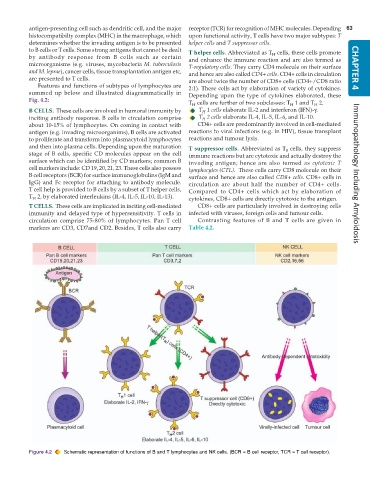
              Features and functions of subtypes of lymphocytes are  2:1). These cells act by elaboration of variety of cytokines.
           summed up below and illustrated diagrammatically in  Depending upon the type of cytokines elaborated, these
           Fig. 4.2:
                                                               T  cells are further of two subclasses: T  1 and T  2.
                                                                 H
                                                                                                 H
                                                                                                         H
           B CELLS.  These cells are involved in humoral immunity by  T  1 cells elaborate IL-2 and interferon (IFN)-γ.
                                                                    H
           inciting antibody response. B cells in circulation comprise  T  2 cells elaborate IL-4, IL-5, IL-6, and IL-10.
                                                                    H
           about 10-15% of lymphocytes. On coming in contact with  CD4+ cells are predominantly involved in cell-mediated
           antigen (e.g. invading microorganims), B cells are activated  reactions to viral infections (e.g. in HIV), tissue transplant
           to proliferate and transform into plasmacytoid lymphocytes  reactions and tumour lysis.
           and then into plasma cells. Depending upon the maturation  T suppressor cells. Abbreviated as T  cells, they suppress
                                                                                                S
           stage of B cells, specific CD molecules appear on the cell  immune reactions but are cytotoxic and actually destroy the
           surface which can be identified by CD markers; common B  invading antigen; hence are also termed as  cytotoxic T
           cell markers include: CD 19, 20, 21, 23. These cells also possess  lymphocytes (CTL).  These cells carry CD8 molecule on their
           B cell receptors (BCR) for surface immunoglobulins (IgM and  surface and hence are also called CD8+ cells. CD8+ cells in  Immunopathology Including Amyloidosis
           IgG) and Fc receptor for attaching to antibody molecule.  circulation are about half the number of CD4+ cells.
           T cell help is provided to B cells by a subset of T helper cells,  Compared to CD4+ cells which act by elaboration of
           T  2, by elaborated interleukins (IL-4, IL-5, IL-10, IL-13).  cytokines, CD8+ cells are directly cytotoxic to the antigen.
            H
           T CELLS.  These cells are implicated in inciting cell-mediated  CD8+ cells are particularly involved in destroying cells
           immunity and delayed type of hypersensitivity. T cells in  infected with viruses, foreign cells and tumour cells.
           circulation comprise 75-80% of lymphocytes. Pan T cell  Contrasting features of B and T cells are given in
           markers are CD3, CD7and CD2. Besides, T cells also carry  Table 4.2.


           Figure 4.2  Schematic representation of functions of B and T lymphocytes and NK cells. (BCR = B cell receptor, TCR = T cell receptor).

