


Page 73 - Textbook of Pathology, 6th Edition
P. 73
57  CHAPTER 3


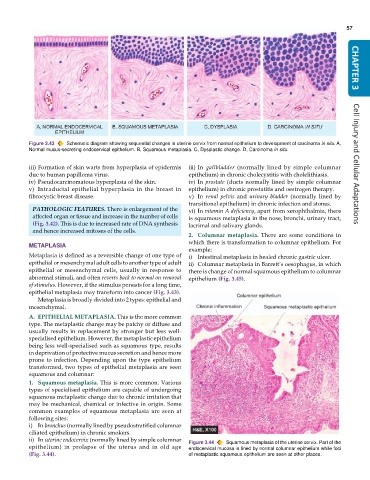
           Figure 3.43  Schematic diagram showing sequential changes in uterine cervix from normal epithelium to development of carcinoma in situ. A,
           Normal mucus-secreting endocervical epithelium. B, Squamous metaplasia. C, Dysplastic change. D, Carcinoma in situ.


           iii) Formation of skin warts from hyperplasia of epidermis  iii) In  gallbladder (normally lined by simple columnar  Cell Injury and Cellular Adaptations
           due to human papilloma virus.                       epithelium) in chronic cholecystitis with cholelithiasis.
           iv) Pseudocarcinomatous hyperplasia of the skin.    iv) In  prostate (ducts normally lined by simple columnar
           v) Intraductal epithelial hyperplasia in the breast in  epithelium) in chronic prostatitis and oestrogen therapy.
           fibrocystic breast disease.                         v) In  renal pelvis and  urinary bladder (normally lined by
                                                               transitional epithelium) in chronic infection and stones.
            PATHOLOGIC FEATURES. There is enlargement of the   vi) In vitamin A deficiency, apart from xerophthalmia, there
            affected organ or tissue and increase in the number of cells  is squamous metaplasia in the nose, bronchi, urinary tract,
            (Fig. 3.42). This is due to increased rate of DNA synthesis  lacrimal and salivary glands.
            and hence increased mitoses of the cells.
                                                               2. Columnar metaplasia.  There are some conditions in
                                                               which there is transformation to columnar epithelium. For
           METAPLASIA
                                                               example:
           Metaplasia is defined as a reversible change of one type of  i) Intestinal metaplasia in healed chronic gastric ulcer.
           epithelial or mesenchymal adult cells to another type of adult  ii) Columnar metaplasia in Barrett’s oesophagus, in which
           epithelial or mesenchymal cells, usually in response to  there is change of normal squamous epithelium to columnar
           abnormal stimuli, and often reverts back to normal on removal  epithelium (Fig. 3.45).
           of stimulus. However, if the stimulus persists for a long time,
           epithelial metaplasia may transform into cancer (Fig. 3.43).
              Metaplasia is broadly divided into 2 types: epithelial and
           mesenchymal.
           A. EPITHELIAL METAPLASIA. This is the more common
           type. The metaplastic change may be patchy or diffuse and
           usually results in replacement by stronger but less well-
           specialised epithelium. However, the metaplastic epithelium
           being less well-specialised such as squamous type, results
           in deprivation of protective mucus secretion and hence more
           prone to infection. Depending upon the type epithelium
           transformed, two types of epithelial metaplasia are seen
           squamous and columnar:
           1. Squamous metaplasia. This is more common. Various
           types of specialised epithelium are capable of undergoing
           squamous metaplastic change due to chronic irritation that
           may be mechanical, chemical or infective in origin. Some
           common examples of squamous metaplasia are seen at
           following sites:
           i) In bronchus (normally lined by pseudostratified columnar
           ciliated epithelium) in chronic smokers.
           ii) In uterine endocervix (normally lined by simple columnar  Figure 3.44  Squamous metaplasia of the uterine cervix. Part of the
           epithelium) in prolapse of the uterus and in old age  endocervical mucosa is lined by normal columnar epithelium while foci
           (Fig. 3.44).                                        of metaplastic squamous epithelium are seen at other places.

