


Page 75 - Textbook of Pathology, 6th Edition
P. 75
59
TABLE 3.7: Differences between Metaplasia and Dysplasia.
Feature Metaplasia Dysplasia
i) Definition Change of one type of epithelial or mesenchymal Disordered cellular development, may be
cell to another type of adult epithelial or mesen- accompanied with hyperplasia or metaplasia
chymal cell
ii) Types Epithelial (squamous, columnar) and Epithelial only CHAPTER 3
mesenchymal (osseous, cartilaginous)
iii) Tissues affected Most commonly affects bronchial mucosa, uterine Uterine cervix, bronchial mucosa
endocervix; others mesenchymal tissues (cartilage,
arteries)
iv) Cellular changes Mature cellular development Disordered cellular development (pleomorphism,
nuclear hyperchromasia, mitosis, loss of polarity)
v) Natural history Reversible on withdrawal of stimulus May regress on removal of inciting stimulus,
or may progress to higher grades of dysplasia
or carcinoma in situ
cells such as neurons and myocytes. The following
CELLULAR AGING Cell Injury and Cellular Adaptations
hypotheses based on investigations explain the cellular basis
Old age is a concept of longevity in human beings. The of aging:
consequences of aging appear after reproductive age. 1. Experimental cellular senescence. By in vitro studies of
However, aging is distinct from mortality and disease tissue culture, it has been observed that cultured human
although aged individuals are more vulnerable to disease. fibroblasts replicate for up to 50 population doublings and
The average age of death of primitive man was barely then the culture dies out. It means that in vitro there is reduced
20-25 years compared to life-expectancy now which is functional capacity to proliferate with age. Studies have
approaching 80 years, survival being longer in women than shown that there is either loss of chromosome 1 or deletion
men (3:2). About a century ago, the main causes of death of its long arm (1q). Alternatively it has been observed that
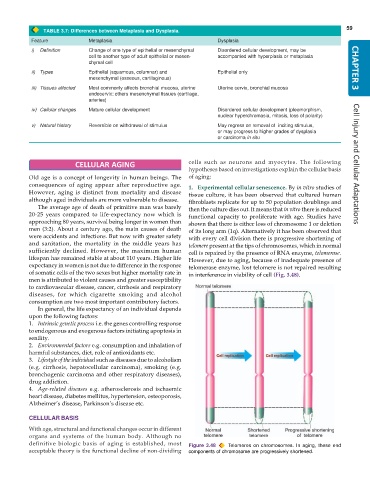
were accidents and infections. But now with greater safety with every cell division there is progressive shortening of
and sanitation, the mortality in the middle years has telomere present at the tips of chromosomes, which in normal
sufficiently declined. However, the maximum human cell is repaired by the presence of RNA enzyme, telomerase.
lifespan has remained stable at about 110 years. Higher life However, due to aging, because of inadequate presence of
expectancy in women is not due to difference in the response telomerase enzyme, lost telomere is not repaired resulting
of somatic cells of the two sexes but higher mortality rate in in interference in viability of cell (Fig. 3.48).
men is attributed to violent causes and greater susceptibility
to cardiovascular disease, cancer, cirrhosis and respiratory
diseases, for which cigarette smoking and alcohol
consumption are two most important contributory factors.
In general, the life expectancy of an individual depends
upon the following factors:
1. Intrinsic genetic process i.e. the genes controlling response
to endogenous and exogenous factors initiating apoptosis in
senility.
2. Environmental factors e.g. consumption and inhalation of
harmful substances, diet, role of antioxidants etc.
3. Lifestyle of the individual such as diseases due to alcoholism
(e.g. cirrhosis, hepatocellular carcinoma), smoking (e.g.
bronchogenic carcinoma and other respiratory diseases),
drug addiction.
4. Age-related diseases e.g. atherosclerosis and ischaemic
heart disease, diabetes mellitus, hypertension, osteoporosis,
Alzheimer’s disease, Parkinson’s disease etc.
CELLULAR BASIS
With age, structural and functional changes occur in different
organs and systems of the human body. Although no
definitive biologic basis of aging is established, most Figure 3.48 Telomeres on chromosomes. In aging, these end
acceptable theory is the functional decline of non-dividing components of chromosome are progressively shortened.

